Tampilkan postingan dengan label research. Tampilkan semua postingan

Kamis, 21 Maret 2013

Little legs

Posted by Linda Penn

I was pleased that the train arrived to take me to Middlesbrough on a freezing January morning, although not so pleased that it was the cold train (heating in this train hasn’t worked for months). By the time I got to Middlesbrough station I was frozen through. Claire picked me up and took me to an annex at the back of what used to be St Cuthbert’s church. In this very cold and rather dark annex was a ‘community gym’ and I was there to interview South Asian women about their physical activity, as part of the evaluation of our preventive intervention feasibility study. By then I was so cold I would have preferred to tramp the treadmill to warm up or maybe even indulge in beginners’ Zumba. However, when the women started talking I forgot to be cold. Qualitative research can be such joy.

St. Cuthbert's Church, Middlesbrough, 1965
St Cuthbert’s church used to be near my uncle’s butchers shop, until the planners bulldozed the community to drive a road through the heart of the town and move people out to a concrete desert. I didn’t know, until my cousin told me recently, but they had apparently sold halal chicken from this shop. So there must have been a Muslim community in Middlesbrough for some time.

My great aunt Minnie’s sweet shop was also somewhere nearby St Cuthbert’s. I think she ran the shop from the front room of one of the little terraced ‘slum’ houses. This house too has long since been reduced to rubble. I only remember going there once and I was very young. Minnie was too old then to keep shop and my sister and I had been warned that Minnie had ‘little legs’. We were not to ask or comment. In fact, we should just pretend we had not noticed. The legs were not at all obvious when we arrived as she was sat in her big chair by the fire, with a rug over her knees. However after a while she got up to fetch the coal from the back kitchen. When she got up she was walking on her knees – the little legs. It was a shock, which must be why I remember. Nevertheless Minnie managed to negotiate down the stone step into the back kitchen to fetch the coal and obviously back up the step with the bucket of coal. I remember watching her. I am sure someone would have offered to go and get the coal for her, but she must have refused with such determination that no-one dared interfere. 

St. Cuthbert's Church, Middlesbrough, 2008
Not until years later did I appreciate that Minnie’s little legs were as a result of diabetes related amputations. That was my first introduction to the nasty, progressive and debilitating disease that is diabetes. It was pure serendipity that this January I was back almost where I started and the prevention message is the same. Although I hope the prosthetics have improved.

Selasa, 12 Maret 2013

Playing in the sand: the joys of peer pressure


Have you ever wondered what would happen if you put 28 stressed-out early career researchers in a country hotel and gave them the option to either enjoy the available swimming pool, spa, snooker room, and pub with sun soaked terraces, or to write a full research proposal of up to 5,000 words with five unknown people in less than four hours and submit their work for scrutiny to a hard-nosed review panel of senior academics and professionals? Remarkably, when Fuse tried this out last week in the Sandpit event at Linden Hall, the result was five serious proposals, steeped in blood, sweat and tears, that somehow managed to persuade the review board to part with £2,500 of prize money.

The distractions were plentiful: giant Jenga, Connect4, indoor cricket, extensive breakfast and lunch buffets, (attempts at) nouveau cuisine diners, tough pub quizzes presided over by quiz-wizard communications officer Mark, log fires with arm chairs, and more coffee, tea and cakes than was healthy to consume, while hero professors bared all (at least their life stories) under large glass chandeliers. In spite of all these temptations, the researchers locked themselves up in their rooms, questioned the wisdom of their mentors, cross-examined policy and practice experts on their chosen subjects, argued and quarrelled at length with each other, and somehow managed to produce something that could pass for a research proposal.


Nerd peer pressure

The secret, you might wonder, is a classic tale of peer pressure, which early careers researchers are especially prone to. What the event allowed them to do was to learn this lesson (and many others in the course of it) and, even better, to enjoy it: a relaxing swim or pint in the pub is much more enjoyable after a chaotic session with five strong minded colleagues who are trying to reach a decision on what topic to choose for their proposal (only to find out later that they were allocated their third choice). A quiz or game of Jenga seems all the more exciting after struggling for three hours to put anything on paper, only to realise you have an hour left to write the remaining 5,000 words.

Therefore, a big thank you is in order for the organisers of the event, particularly to Avril, who had to miss out on many of the temptations due to a sudden bout of flu, and to quizmaster Mark, who clearly has too much free time on his hand to come up with the questions he did.

Kamis, 07 Maret 2013

Horizon scanning

Posted by Linda Penn

As I watched the midnight sun skim the lake horizon in Finland, I should have remembered there are ‘no free lunches’. Collating the European Diabetes Prevention Study (EDIPS) data required much effort and was mostly a spare time endeavour for Jaana, Annemieke, and me. Our first tangible reward, to which all co-authors have contributed much thought and substantial quantities of virtual red-ink, is our publication in PLoS ONE.  

Midnight sun in Finland

There are three main messages in this paper:

1. Type 2 diabetes can be prevented by lifestyle intervention in European countries (including the UK, and not just in Finland - which was already known).

2. Weight loss has a diabetes preventive effect and maintaining weight loss for more than a year has a greater (quite dramatic) preventive effect.

3. Convenient identification of people at high-risk, so that interventions can be offered to the right people, remains unclear (and research is needed).

Drafting, redrafting and re-redrafting this paper was a learning experience and a privilege. As any first author may appreciate, coordinating input from my co-author list of illustrious professors might incur challenges. Since publication I have received several complimentary responses from colleagues - such is the power of social media - and I am satisfied that this paper represents good research. However it is just research. Translation to sustainable service provision remains the goal. Finland has made progress in this direction, but in the UK it is raining costs and cut-backs.

Recent NICE guidance for prevention of type 2 diabetes confirms the need for intensive lifestyle intervention services, and we are currently evaluating a translational feasibility study in Middlesbrough that is based on our EDIPS experience. We also plan further EDIPS publications. We agreed outlines for these during a November meeting in Helsinki. Finland was different in November - no sun, horizontal sleet and frozen snow - but still warm hospitality.

I have the additional bonus of including this paper in my portfolio towards my PhD by publication, which is of course the soft option for a PhD – or perhaps not. I wonder if I can include a Fuse Blog post as supporting documentation?

Kamis, 28 Februari 2013

The day the media circus came to town

Posted by Jean Adams

Is it more scary when Monty Don slags off your research on Twitter, or when a professor who you respect a lot asks you nicely to be a bit more careful with your not-quite-what-it-was-designed-for use of his carefully developed tool (also on Twitter)? How about both on one day?

What seems like a long time ago now, an MSc student emailed to ask if I’d be interested in chatting about an idea he had for a dissertation project.

His idea was simple: compare the nutritional quality of ready meals to celebrity chef meals. I don’t think the student (now graduate) in question would mind me saying that he’s not unfamiliar with a ready meal, or currently maintaining his weight within the recommended BMI range. Slightly fed up with being told his ready meal habit was bad for him, he was interested in finding out just how bad and whether it was any worse than the alternative that seemed to be in his face whenever he was eating his ready meals – something served up by Nigella, Jamie or Hugh.

In contrast, I and my co-supervisor were backing the celeb chefs. I don’t think I’ve ever eaten a ready meal, and it is possible that I have an affinity for glossy recipe books that has resulted in a collection that outgrew the kitchen bookcase some time ago. Scientists are neutral (not). We might be able to collect and analyse the data objectively, but it was clear what results each member of the research team was hoping to find.

The project was perfect for an MSc dissertation: clear research question, data collection primarily via the web, fairly straightforward analysis, no ethics permission required. We joked in supervision that the BMJ would love it.

And so it came to pass that the student collected and analysed his data, perhaps stretched the use of front of pack labelling for a good gimmicky visual a bit too far, got a good mark, and toddled off back to his real job promising to send us a draft of a paper sometime. Often those manuscripts never materialise. But lo! This one did. I wasn’t absolutely convinced that the BMJ really would love it, but we’d said they would and it seemed a shame not to try. They say ‘no’ pretty quickly.

I was mildly offended when the BMJ’s response to our rather serious and important piece of work was that it was “quirky” enough for their Christmas edition. Sure it was fun and sure I wasn’t quite convinced that it was good enough piece of work to be considered normal BMJ material. But there is a serious point here: lots of public health advice suggests that people should cook from scratch and implies this is better for you than eating ready meals. If you don’t know how to cook from scratch, then it isn’t a wild assumption to suggest that you might learn from the most prominent cooks around – celebrity TV chefs. A nutritional comparison of the two doesn’t seem outrageous.

Presumably you know what our findings were? We found that, on a number of nutritional metrics, ready meals did better than celebrity chef meals, but neither of them did very well. The ready meals were less unhealthy than the celeb chef meals, but it would probably not be right to say the ready meals were healthier than the celeb chef meals.

I knew what was going to happen. I didn’t have any idea how to stop it happening. Perhaps there was none.

The BMJ went to town promoting our paper. The media loved it. We got on the Today programme headlines, the paper was covered by loads of newspapers and not just in the UK, all three of us spent most of publication day doing interviews with just about everyone and their dog. But however much we tried, it was very difficult to get the message across that neither group of meals were particularly good for you – we were definitely not saying that ready meals are the way to go. But that’s the message that everyone seemed to hear.

Ho hum. What can you do? The media circus would move on. No-one would remember. And presumably any colleagues who would, might take the time to read the paper (or at least the abstract), and not just go on what was in the newspapers?

I can understand why people went for the “ready meals healthier than celeb chefs” headline and why that then prompted all the various responses it did. But I was most bothered by Monty Don’s response. And not just because I’ve always thought he seemed like a nice, and thoughtful, guy.


Do lots of people think scientists should only do, and publish, studies that come up with the ‘right’ results? That we should make sure the measures we use are designed to come up with those ‘right’ results? What about Ben Goldacre and the All Trials campaign for open data and publication of all trial results – not just positive ones? How does that match with this attitude? Or maybe I’m assuming that Monty is more representative of ‘the public’ than he really is.

Kamis, 24 Januari 2013

Ignoring the ‘experts’ and sticking with the hard to follow guidance as a mom

Posted by Liane Azevedo

Being a Mom has changed my research interests. Now, every time I see something related to physical activity, diet or even sleeping behaviour in early childhood it grabs my attention.

However, I must confess that it is not always easy to follow the public health recommendations that are set for moms on how we should raise our children. More important, I think, is to fight against the pressure that you receive from family, friends and sometimes complete strangers to follow their guidance.

For me this started with breastfeeding. Being born in Brazil where breastfeeding is the rule rather than exception, I have never considered any other option. However, I must say this hasn’t been an easy process. I faced several challenges including mastitis, bleeding, and the fact that my son woke every hour during the night to breastfeed. As soon as I mentioned these problems to other people the first advice I received was, “Give him a bottle.” But I don't want to give him a bottle. Then you’re told that your milk must be weak, which is why he is waking up every hour and so on... (Note: my son was born on the 50th percentile and after 4 months he was on the 90th just with breastfeeding). 

Pieter de Hooch: Mother nursing her child, c1674 
People appear to want to impart their ‘expertise’ on every phase of his development. They say: “Why did you let your child feed himself? Now he is a fussy eater and look at the mess he does! Look at my son he is 2 and I still feed him and he is not a fussy eater”. Then when it comes to sleep they suggest the use of techniques such as ’control crying’, in which you let your child cry until he/she settles down. Being a very soft mom (I know I will pay for this later in his teenage years), I can’t cope with this idea. Luckily, I found some scientific evidence to support my decision (you can always find what you want to, when you search for it). According to this paper “Leaving an infant unattended and in distress, advocated by many clinicians, is not the only efficacious method by which sleep consolidation can be achieved and may not be either necessary, ethical or biologically sound.” It basically says that crying is the way a child communicates with its parents and by ignoring it, you will be blocking this communication. So, that will do as justification for me.

This all reminds me of a presentation I saw recently at the North East Physical Activity Forum, with the intriguing title: “Why we should shut up about the long-term benefits of physical activity”. Although the presenter didn’t give any scientific evidence to her comments, the main message was that long-term benefits of physical activity cannot persuade people to start physical activity. So, we should advocate the short-term benefits such as “have more energy”, “sleep better”, “meet people”, and “reduce anxieties, worries and depression”. I don’t necessarily agree with her comments, probably because I work in this field and the long-term benefits strike me more than the short ones. But this might be worth investigating. However, if I decided to look for the short term-benefits on how to raise my child, I would probably be doing everything against the recommendations. Don’t breastfeed, let him cry himself to sleep, and leave him in front of the TV so you can have your own time. I’ve learnt that sometimes you need to stick with hard to follow guidance to see the benefits which, might take a while to show but, are much more important than the immediate comfort that you would probably get from not following them.

Selasa, 18 Desember 2012

Time management

Posted by Lynne Forrest

I constantly worry that I’m not spending enough time on my PhD. When I hear of other people who work weekends and do 60-hour weeks then I definitely feel that I’m not putting enough hours in. I struggle with fitting a full-time PhD around all my other life-commitments. And I worry that this makes me look like I’m not taking it seriously, when I definitely am.

I’m lucky enough to be a full-time, fully-funded PhD student and I’m totally in awe of those people who are fitting in a PhD around working. I really don’t know how they do it. It’s hard enough to find enough hours in the day without having to juggle a job as well.

I presume that if my supervisors thought I was skiving off, they'd have said something by now
Prior to the PhD I worked part-time whilst my children were little. So the switch to a full-time PhD commitment was initially a bit of a culture shock to everyone. I was no longer able to attend all the school plays, concerts and sports events I used to and my children did guilt-trip me with this. Once everyone had adjusted their expectations it became manageable.

When I started the PhD I decided to give up my gym membership as I couldn’t find the time to go. However, as I spend most of my working day sitting down analysing data I found that the weight was creeping on, so this was probably not the best idea. So I’ve decided I need to fit exercise back into my life – I’m just not quite sure how I’m going to manage this. I’m currently experimenting with going running and am in the early, enthused stage of taking up an exercise regime. So when this wears off it can give me something else to feel guilty about. When I’m exercising I can worry about not doing enough hours on the PhD and when I don’t get round to exercising I can feel bad about that too….

A couple of days a week I finish at 4pm to do the school pick-up and encounter the usual guilt as I furtively sneak off early out of the office. I do a further hour or so when I get home but this can be regularly interrupted and so isn’t ideal. I actually find working from home really difficult as it’s too easy to become distracted by all the domestic drudgery that needs done. I prefer to work in the office and, even though I have to factor in travel time, I’m definitely much more productive. To maximise work time I just eat a quick lunch at my desk and do sometimes feel I’m missing out on being more sociable, but I really can’t spare the time.

I am aware how lucky I am to be able to work this flexibly and I know how much more difficult it is outside academia. In one of my (many!) previous jobs I worked as a computer programmer for a large Scottish bank. All staff had to clock in and out and, although there was some flexibility, a core 7 hour day had to be worked. All time spent on a project also had to be logged weekly under different headings and I really hated having to account for every hour in this way. I love the flexibility of academia where, within reason, you can spend as long as you need on a task without your every action being scrutinised.

Anyway, I presume that if my supervisors thought that I was skiving off then they’d have said something by now. As it is, my PhD does seem to be going pretty well. As much as possible I’ve attended conferences, done external training courses that have meant staying away for days at a time and have also tried to get involved with other aspects of the Institute where I work. But I’m aware that other people are in earlier and work later. I just have to keep reminding myself that it’s quality not quantity that counts. And that I’d be worried if I didn’t have something to worry about…

Selasa, 04 Desember 2012

Some memorable participants

Posted by Rachel Stocker

During the last year (which comprised the second year of my PhD) I have embarked upon a roller-coaster of emotions. Not only as a consequence of the usual trials of a PhD journey, but through data collection. I’m primarily a qualitative researcher, and my study involves interviewing people with heart failure, and their carers, to discuss their prognosis.

OK, I thought, no problem. The only issue I would need to consider would be if they found the topic upsetting, and I prepared myself for that possibility and the resources I would need to access. What I wasn’t prepared for was the sheer diversity of participants, and the depth which I would see their lives. 

I have been welcomed into all my participant’s homes and shown, with open arms, how they live. One particular interview which remains firmly in my memory was with a gentleman who I had been advised had severe (physical) difficulties with verbal communication and whose wife could not participate due to similar, cognitive communication, difficulties. 

A nice cup of tea and a biscuit
Oh dear – this is going to be challenging, I thought. I wasn’t really looking forward to the interview. I knew there would be issues with communication, and I wondered how best to sensitively conduct the interview. Upon arrival, I was welcomed as an old friend and given endless cups of tea and home-made scones (fruit AND cheese!). I was taken by the hand and shown round the couple’s quaint bungalow, containing endless self-made paintings and artwork. I was told about their families and their service in WWII. The interview went well and I left feeling happy, with a twinge of sadness at the parts of their lives they had lost. 

Another memorable participant told me about her life, her late husband, and her parents (mother French, father English – she spoke in a perfect French accent despite living in England all her life). She lived with her son, a very personable, jolly fella who joked about her stubbornness. She visited the local hospice regularly to socialise with “other people my own age”, play dominos, and enjoy lunch. (Her son interjected at this point to say that she comes back three sheets to the wind as they all have an ‘aperitif’ beforehand). She did not offer any other reason for attending the hospice and did not think it was related to her health at all. She died three months later, peacefully in her sleep.

I’m conducting six-month follow-up interviews with participants (where possible, however heart failure is a cruel disease), so I get to return to their homes and speak to them again. I noticed one lady was looking much better than when I saw her six months ago, and told her. Her husband said that she had been looking forward to my visit for the past few days and seeing me perked her up. I re-interviewed them like old friends, with their dog sat on my knee – turning my black trousers white with his fur but I didn’t mind at all - whilst I supped my tea and ate two of the five assorted biscuits arranged on the plate.

Interviewing my participants has illustrated to me that there’s much more to life than research (and indeed, living with heart failure) and reminded me of the fine line between living and dying.

Selasa, 27 November 2012

Evaluating a complex public health intervention – is there an app for that?

Guest post by Oliver Francis, Centre for Diet and Activity Research

When it came to tools, early hominids were happy with a stone axe and a few sticks to rub together to make fire. Now we are massively more advanced and instead have an iPhone App that can blow out candles (yes, really.)

But most problems we face are a bit trickier, and don’t fall easily under the capability of simple tools. Evaluating a complex public health intervention is certainly something that is fraught with nuance and difficulty. Even to a man with a hammer, it doesn’t look like a nail.

This is not to say there isn’t help at hand for anyone considering various types of evaluation – there is. There’s a growing number of high quality manuals and guides that stretch from the academic to the practical – from the MRC’s Developing and Evaluating Complex Interventions: new guidance, to the National Obesity Observatory’s Standard Evaluation Frameworks.

However, when thinking about the evaluation of complex public health interventions there is not always a single path to take, or even necessarily a ‘right answer’. And crucially it is not possible, and sometimes not desirable, to evaluate everything. 
Standardisation is difficult
As the authors of Assessing the Evaluability of Complex Public Health Interventions: Five Questions for Researchers, Funders and Policy Makers (who include CEDAR’s David Ogilvie and Andy Jones and Fuse’s Martin White) put it:

“Evidence to support government programs to improve public health is often week. Recognition of this knowledge gap has led to calls for more and better evaluation, but decisions about priorities for evaluation also need to be addressed in regard to financial restraint.”

Using England's ‘Healthy Towns’ initiative as a case study, the article above presents five questions to stimulate and structure debate in order to help people make decisions about evaluation within and between complex public health interventions:
  • Where is a particular intervention situated in the evolutionary flowchart of an overall intervention program? 
  • How will an evaluative study of this intervention affect policy decisions? 
  • What are the plausible sizes and distribution of the intervention's hypothesized impacts? 
  • How will the findings of an evaluative study add value to the existing scientific evidence? 
  • Is it practicable to evaluate the intervention in the time available? 
It is these five questions that form the heart of a proposed ‘thinking tool’ which will extend the reach of the original paper to a wider practice and policy audience. Built primarily around an interactive website (and maybe in time an iPad app), this tool will help people make decisions about whether to evaluate, about when to evaluate, and about what to evaluate first. So that it doesn’t duplicate existing manuals it will also contain a wealth of links and signposts to the existing resources about how to evaluate.

But what do we mean by a thinking tool? Well, in a pre-digital world, this can be as simple as making a list of pros and cons for a decision. Or something more involved such as Edward de Bono's Six Thinking Hats, a stakeholder mapping chart, or a SWOT analysis (Strengths, Weaknesses, Opportunities, Threats). And in the online and mobile world, there are a growing field of thinking and project tools such as Mindjet or Basecamp. Obviously our thinking tool will be more tailored than these, but the goal is to produce something that can be applied to a wide range of intervention within – and possibly beyond – public health.

We’re keeping an open mind about exactly how our thinking tool might work, so it would be good to hear your thoughts. You can read some more about the plans here, or get in touch with me at ocf26@medschl.cam.ac.uk / 01223 746892.

Selasa, 13 November 2012

My PhD Experience

Posted by Annette Payne

The world of ‘The PhD’ was a complete unknown to me, one I never thought I would be part of until a ‘casual’ conversation in 2010.

I remember in 1988 waiting for my GCSE results thinking I would be lucky to pass any…..I ended up with 10!! Don’t get me wrong they weren't ‘A’ grades but they were C and above and got me onto my A-level courses……

I remember in 1990 waiting for my A-level results thinking I would be lucky to pass any…. I ended up with three!! Don’t get me wrong they weren't ‘A’ grades but they got me into university…….

Never an A-grade student

HANG ON! HANG ON! There is a theme here!! I'm now 40 (coughs) and can look back on my academic achievements (BA Hons, BSc Hons, Dip He, PGCE, MSc in case you’re interested) and see that I have finally found myself academically. I was never an ‘A’ student and always having degrees of shock when I academically achieved. I still don’t class myself as an ‘A’ student. Ask if I'm clever I’ll say no (my basis for this is I hate trivial pursuit, am rubbish at geography and can’t really speak any foreign languages apart from my bad hybrid Greek). BUT I have gained a few qualifications along the way. 

I was approached about doing a PhD in 2007 to which the polite version of my response was NO WAY!! I had just completed a three-year part-time MSc in two years while working full time and the thought of any other study, never mind the elusive PhD, was not on my to do list!!! The seed must have been sown however, because in 2010 I ventured over to Sunderland University for a ‘casual’ chat with the Professor of Nursing. I walked away with the offer of a PhD ringing in my ears. I remember my journey home that day so clearly. The words ‘oh my goodness I'm doing a PhD, I’m doing a PhD’ were being chanted non-stop in my head. I wasn't entirely sure how it had happened but from that moment, so began my PhD journey.

The reason for my shock was twofold. Firstly I never believed I was capable of completing the study required for a PhD - again not thinking I was clever enough. Secondly I was totally taken aback at the ease at which I was offered my PhD and the surprise the Prof demonstrated when I questioned my ability.

So after 12 months of work-up I finally registered in Feb 2011 and am now heading at speed towards the end of my second year. To my amazement I've sailed through all of my reviews, received a highly commended for my research at a nursing conference, had a couple of poster presentations, achieved some success with funding and had national interest in my research all of which without actually having any results. I've received my postal surveys back and have my first interviews scheduled next week OH MY GOODNESS I'M DOING A PHD!!!

As I said at the start of this post (my first by the way) the world of the PhD was a complete unknown to me and one I never thought I would be part of but I am now fully immersed in it. I can negotiate the bureaucratic process, the on-line library facilities, the studying alongside a full time job while having a life and finally realise I am quite bright (although still maintain that I'm not classically intelligent) but I have I think learnt how to study. My PhD has shown me that if you enjoy, or even love, what you are studying you can achieve as much as you desire. When I was at school my choice of subject was restricted (funnily enough I had little interest in learning Russian) and I think my academic attainment reflected this. As my academic career has progressed my choices on what I study have broadened and therefore so has my academic attainment and self-belief. You may ask why at the age of 40 (coughs) am I so determined and excited to complete my Doctorate?? The answer to that is very simple I long to be Dr A Payne. Mwhaaha haa ha ha (evil laugh).

Selasa, 16 Oktober 2012

Are we asking the right question?

Posted by Bronia Arnott

Recently I wrote about using twitter to recruit participants for a research study and how others said it couldn't be done. But were they asking the right question? Should they be asking if it SHOULD be done?

When I tweet to my followers on twitter I am sending information out to people who are like minded individuals. They probably follow me because they share some of my interests and probably because they like me have been caught up in the fallout from the weapon of mass distraction that is the Internet. So are these the kind of people I should be trying to recruit for a research study? A large proportion of them have a PhD and many work in academia (and I know how strange academics can be!). Even if they don't fall into those categories they tend to be those interested in mental or physical health, quite well educated, or my friends - which might not be very inclusive!

Reduce, reuse, retweet
But before I shoot down my research paper with the biased sample bullet let's take the finger off the trigger for a moment. Of course those things are true of my followers, but what about the followers of those who re-tweeted (RT'd) my requests for participants? Their followers may be more diverse than my own - especially those such as local radio stations who kindly RT'd. So, in theory, the further the RT was RT'd the more likely I was reaching people who were not that similar to me.

Taking another step back from the big red button, what kind of participants did I want to recruit? Well I was actually looking for adults of working age who regularly commute and own a smartphone – so if twitter users tend to be adults of working age who regularly commute and own a smartphone then perhaps that isn’t a problem?

However, while most twitterers are lovely (and recruiting this way allowed me to meet some of them who I may not otherwise have had the opportunity to meet) they are clearly different in many ways to those who don’t use twitter. Therefore while I do think people can and should recruit via twitter I don't think it should be the only method of recruitment. Unless you want to measure the effect of the weapon of mass destruction that is the Internet, then go ahead.

But enough about what I think, what are your thoughts?

Selasa, 09 Oktober 2012

They said it couldn't be done…

Posted by Bronia Arnott

Recently I needed to recruit some participants for a user engagement study that we were organising as part of our research. I had had in my mind for a while that I would probably try to recruit some participants via twitter. Anyone who knows me knows that I am a twitter advocate. I had been thinking about this idea for a while. However, when I mentioned my plan to others they said that they didn't think it could be done...

The Incredulity of Saint Thomas, by Caravaggio
Due to some unexpected delays on the project I realised that my brief recruitment timescale was going to coincide with moving house and my daughter starting preschool. I negotiated to have time off as long as long as I could recruit participants while I was on leave. The appeal of a twitter recruitment drive became even more appealing. I thought maybe I should probably have a strategy (or maybe I was just procrastinating) so I checked out what times of the day were most likely to get Re-tweets and put my academic writing skills to the test trying to summarise the user engagement studies into the 140 characters allowed by twitter. I also thought about targeting specific people who I followed or who followed me (or our research project twitter account) and asking them to Re-tweet to their followers. "Shy bairns get nowt" and all that.

Soon the RTs were coming in and so were the hits on our project website. Slowly but surely the sessions filled up. So were the doubters right? It wasn't as successful as I would have liked but I think there were a few reasons for that: we had very specific inclusion criteria, limited time, no funds, and for some of the time I had no Internet access (the provider who messed up not once but twice will remain nameless).

I think in the end researchers probably can recruit using twitter. Whether they should or not is a different question...

Selasa, 02 Oktober 2012

Things I’ve learnt from being on a funding board

Posted by Jean Adams

A few years ago I was invited to join a research funding board. I said yes, because: I was flattered to be joining the esteemed ranks of ‘important’ people on such committees; I thought it would look good on my CV; and everyone says you learn a lot about writing grant applications from being on a funding board.

So, in the best tradition of reflexive practice, I thought it might be time to try and work out exactly what it is I have learnt from the experience. These are just some initial reflections and I think they’re probably fairly specific to the committee that I am on. Whatever else you think, do not think that this is a set of rules for winning research funding. I am nowhere near confident enough in my own grant winning ability to start offering anyone else advice.


First, an outline of the process. There are 17 members of the committee, including three ‘lay’ members. All applications go through an initial screening process where a sub-committee of three members confirm the application is in scope. At the full board, each application (which contains around 50-60 pages of application form, references, reviewers’ comments, budgets etc) is assigned a lead and second academic assessor, and a lay assessor. The lead academic assessor summarises the application to the rest of the committee, summing up both strengths and weaknesses. The second and lay assessors are then invited to add any additional comments before opening up the discussion to the full membership. Each application gets 15 minutes and once the lead, second and lay assessors have done their bits, this means around 5-7mins of actual discussion. We deal with anything between four and 16 applications per meeting.

Being a member of this board takes up a lot of time. I started out trying to read all applications in detail prior to each meeting. Then I noticed that other committee members didn’t seem to be doing this, and that it was taking me up to two days per meeting. Increasingly, I find that I don’t have time to read each application fully, so I concentrate on the applications I’m lead or second for and skim the others. This means that perhaps only four people (lead, second and lay assessors, and chair) have a really good knowledge of each application. It seems inevitable that some good applications will get rejected, and some not so good ones funded, just because of how these four individuals respond to them.

I find the meetings pretty scary. To begin with I found it absolutely terrifying having to present my critique of applications to a room full of my elders and betters. Now I’m used to that, but am still not immune to the late nights, Sunday afternoons, commitment, and life-compromise that has gone into preparing every application. Often I find it scary how quickly we deal with them. I worry that we don’t treat the applications we receive as we would want our applications to be treated. But, realistically, how could we do it better? The process has to be manageable. We can’t let each meeting turn into a three-day critical appraisal marathon.

The committee know the guidance that applies to our funding scheme pretty well. I am always surprised that applicants don’t read, don’t act on, or somehow don't think this guidance applies to them. It is all fairly standard stuff on the difference between a pilot study and a full trial; the sort of inter-disciplinary working we expect; and the level of patient and public involvement required. Why would people think that it somehow isn’t relevant to them?

Reviewers’ comments rarely make or break an application. I was pretty surprised by this, because when you’re writing, and re-writing, a grant “what the reviewers will think” seems to be a key determinant of what goes in. Maybe I mis-interpreted “reviewers” too literally and what is meant is just “the people who will make the decision”. But, really, we read the applications and make our own decisions then see if the reviewers picked up anything important that we missed. The reviews are often pretty superficial, so we don’t always expect to find much additional information there. The confusion might be that the applicants are fed back the reviews in full, but just a bullet-point summary of the committee's thoughts. So I guess it might feel that these are what matter the most.

And that might be it for what I've learnt. Does any of this surprise you? I’m not sure it will change the way I approach grant writing in the future. But it’s certainly an interesting experience and the hotel the meetings are held in does good cake.

Kamis, 20 September 2012

Making the connection

Guest post by Kathryn Oliver

About 2 years ago, I had one of those ‘Eureka’ moments that totally changed my life. Genuinely. It was right up there with finding out about Oyster cards, or washing machines, or something.

At the time, I was a PhD student in my first year, working on a fairly standard project about developing health indicators. As a project, it was fine – about the use of evidence by policy makers, one of my main interests, and I was getting lots of experience in survey design. But for years, I’d been kicking round ideas in my head about the importance of personal relations. Didn’t they really explain nearly all human behaviour? Weren’t peer effects important for the spread of obesity or smoking? Wasn’t social capital important for mental health?

I’d been living on my own in London for a year or two and had found myself pondering the role of human relationships more and more. Of course, I had friends and relations, but I also liked being known by the man in the newsagents and the end of the road, and saying 'hi' to the neighbours. Did they count, I wondered? Would these relationships be enough to protect me from isolation, or going ballistic on the tube?

Imagine my delight when, attending a Social Network Analysis seminar day, run by the Mitchell Centre at the University of Manchester, I discovered an entire body of research – methods, philosophy, approaches – which looked at connections between individuals using formal statistical methods. Finding out that other people had had similar ideas to me, and had developed dedicated research methods to investigating these ideas was probably one of the best research moments I’ve ever had.

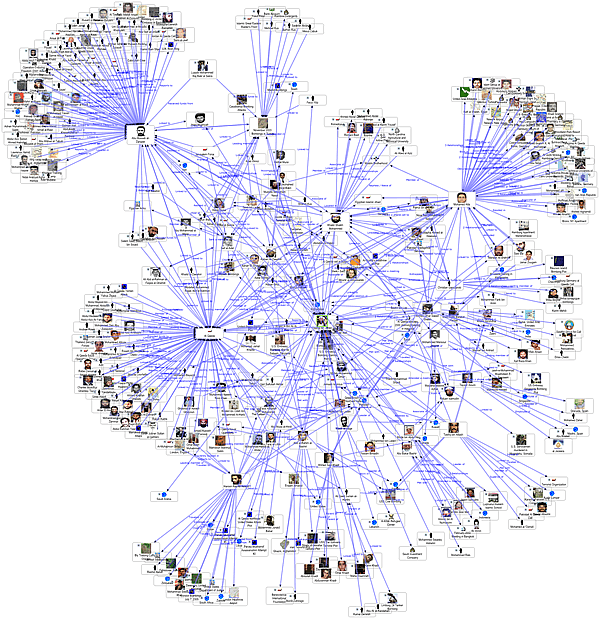
Unlike traditional statistics, network analysis does not treat individuals (whether bridgespolicy makers, or swingers) as independent. Instead, any ties between actors are identified, described quantitatively and/or qualitatively and mapped. The statistics used are based on graph theory, but you don’t have to understand it to admire the elegance and usefulness of network analysis. Depending on the relationship collected, people’s attitudes, behaviours, health outcomes and more can be predicted.

For me, this is really the missing element from a lot of public health research. It can be used to identify good targets for research, or opinion leaders in secondary schools, so more targeted messages can be produced and sent out. It allows us to understand, describe, and analyse the social context within which individuals live. And, of course, make beautiful pictures. 

Example of Social Network Analysis diagram.
People have used network analysis to study all kinds of things – it’s very popular in the business world to identify ‘future leaders’ or ‘people who make things happen within my business’. Researchers have compared US senators voting patterns to cows who lick one another.

My PhD changed quite a lot after this seminar. I ended up using a combination of social network analysis and ethnography to study where public health policy makers found evidence, who the main sources of evidence were and how evidence was incorporated in the policy process. For years, academics in my field have been talking about the importance of interpersonal knowledge translation and how policy makers prefer to get their info from real people. Now I’ve been able to add my own tiny part of the story, come up with new research ideas on the basis of my findings, and learn a niche method (always useful).

My boyfriend still calls them snog webs though.

Rabu, 19 September 2012

Criticism is your friend. I mean it. Really.

Guest post from Emily Murray

Ah, criticism. It is the architecture of the scientific process. Manuscripts are written describing hypothesis of the way we think the world works. But before our hypothesis can be transmitted to the world, we must submit these little pieces of ourselves to others to rip to shreds.

After we’ve re-written the manuscript a few times until it vaguely resembles the work of art we created before, we must submit it to a whole new group of ‘criticizers’, aka reviewers.

Where they commence to rip it to shreds as well.


If we’re lucky, when writing this manuscript (and hopefully 10 others) we discover a hole in the literature. And some twisted part of our brain thinks it would be a fantastic idea to spend six months, weekends and evenings included, turning that ‘hole in the literature’ into a 100-page document of why you are the best researcher ever and will cure all of the world’s ills with this one research project, aka a ‘grant proposal’.

Where they won’t even bother to rip it to shreds. They will only tell you that it did not score high enough to be ripped to shreds.

As you may or may not be able to tell…I hate criticism.

During my student days, I used to loath the days I would receive feedback from my mentor; praying that at least one page wouldn’t be covered in red track changes. Sometimes I would have day dreams where papers were returned to me in their original black-and-white pristine condition with only a note on top saying, “This is fantastic! You must submit this to the Lancet at once!”


But then something happened. My dream came true! (Well, minus the Lancet comment.) I sent out a paper to co-authors and most were returned with nary a comment. I started to think that maybe all of those hours of writing and re-writing and re-re-writing were starting to pay off. Maybe something had clicked in my brain over the last fortnight to push me from a ‘so-so writer’ into a ‘fantastic writer’. Malcolm Gladwell, eat your heart out.

Well, you can guess what happened when I submitted the paper to a journal.

It was rejected. 

*cue copious weeping* 

But seriously, there was definitely a lesson here: Lots and lots of criticism and feedback from mentor and co-authors equaled acceptance. Little to no criticism from mentor and co-authors equaled rejection.

No, the lesson is not that I suck as a writer and should take up a profession in travel photography instead (although this does sound quite attractive in the middle of a second revise and resubmit).

What I drew from this is that sometimes *wait for it* criticism can be a good thing. That criticism is an opportunity in disguise. A way for others to point out the weaknesses in our work, not because they hate us or think our work is appalling, but because they want to help us make it better. Or at least that’s the way I like to think about it.

For those new to this way of thinking, I present both my ‘old’ and ‘present’ way of reacting to certain criticisms:

1. The Grammar Police have gone through my paper with a vengeance. Commas, active verbs, plurals, and future conditional tenses are apparently problems for me.

‘Old’ reaction: Obviously, all previous English Teachers were lacking. I suck.

‘Present’ reaction: Find colleague who is also ‘Grammar Police’ and bribe them to read all future papers.

2. “I don’t understand why you XXX…”

‘Old’ reaction: Obviously, my ability to express my thoughts in plain English is lacking. I suck.

‘Present’ reaction: Realize that I didn’t do a good job of explaining that section. Read it out loud to myself. Or have someone read the section who has never read it before. Like my mother. Oh wait, she has heard it like 50 times before…on to the next guinea pig… 

3. “Have you thought about this? Or tried this? What happens?” 

‘Old’ reaction: Great, there goes my weekend running all of this analysis over again. They suck.

‘Present’ reaction: Ah, I didn’t think of that. Doing this extra work will help me better understand the patterns in my data.

4. “… [no comments]”

‘Old’ reaction: I am a genius.

‘Present’ reaction: Hm, I need to find someone to read this who is willing to rip me to shreds. My paper will be much better for it.

Senin, 17 September 2012

This is what evidence is made of

Posted by Jean Adams

I recently re-joined the systematic review club. I did a systematic review once. It was fine. I learnt how to do it, I did it, I published it. It was a good learning experience. Certainly good enough to learn that I didn’t need to do another one in a hurry. Or at least I didn’t need to do the nitty-gritty reviewing myself. But things happen and before you know it you’re second reviewer on a systematic review that you just can’t pass on to anyone else. 
I love a good (and sometimes not so good) radio drama
There are some jobs that were designed to be Friday afternoon jobs. Jobs that clearly need to be done, but that you don’t need to think too hard about. Jobs that you can do whilst catching up on BBC Radio 4 drama serials on the iPlayer. Reformatting the tables in your latest rejected manuscript to meet the exact, esoteric, requirements for the next journal in your list. Adding references from Endnote into Word.

I love a little pile of Friday afternoon jobs. As they don’t require much brain input, I find them easy to churn through and they make me feel unusually productive. Productive, unthinking, with added radio stories. Just what I need to end the week.

In contrast, other jobs are very clearly Tuesday morning jobs. Jobs that need sustained, un-interrupted thought. Jobs where even Radio 3 is intrusive. Drafting the justification section of grant applications. Deciding what exactly is the key message in your latest paper. Working out the analysis plan for the 3MB of data you’ve just received.

I don’t mind Tuesday morning jobs. If I have the time, the space, the right environment and am making progress, I really like the satisfaction of biting off big chunks of Tuesday morning jobs. In fact, high quality Tuesday mornings jobs are what keep me in the job.

I know some people don’t mind systematic reviewing. I know some people even positively enjoy systematic reviewing. These are wonderful people. We need systematic reviews and we need systematic reviewers. I am pleased to count systematic reviewers among my friends. But, really, I am not a systematic reviewer. I’m always happy to come up with the idea and justification for a systematic review on a quiet Tuesday morning. But the real-life screening and data extraction, bread and butter of systematic reviewing are not my bag at all.

The problem, I have decided, with systematic reviewing, is that it is neither a Friday afternoon job, nor a Tuesday morning job. You need to concentrate to decide if the paper you’re reading meets all of the inclusion criteria you’ve set. You can’t possibly listen to radio stories whilst you’re systematic reviewing. But you don’t really have to come up with any great new ideas. The ideas happened way back on a Tuesday morning in November when you drafted the protocol.

I procrastinate outrageously when I am systematic reviewing. I check Twitter. I make a cup of tea. I decide I’m procrastinating too much and that I must not do anything but review until I have reviewed 10 more papers. I wonder what’s happening in the tennis and convince myself that I’ll review much better if I just check the scores and get it out of my system. I think of blog posts I could write.

But, as I am slogging my way through and slowly passing papers from the ‘to screen’ to the ‘screened’ pile, I try and remember that it is systematic reviews that we hope might guide decisions; that this pain is what evidence is made of.

Kamis, 13 September 2012

On evidence

Posted by Simon Howard

In my first week at medical school, one of the professors warned that most of what we were to be taught was factually wrong. It was an arresting statement, but it may have been true: Studies have shown that textbooks and experts frequently lag behind evidence, sometimes recommending “treatments” that are actually known to be harmful.

Do Primary Care Trusts do the same? PCTs, like the one I work in, currently commission the majority of NHS services provided to patients in their catchment areas (though not for much longer). Sometimes, academics get frustrated with PCTs for seemingly doing things that either have little evidence, or appear to contradict it altogether. Given that evidence is the bedrock of public health, and given the potential for decisions to affect whole populations, this might seem worrying.


In defence of PCTs, a lot of evidence based work does happen. Most major pieces of work include a review of academic literature at an early stage, and follow the findings. The annual Joint Strategic Needs Assessment and regular detailed Health Needs Assessments also take into account published literature and local and national data in a fairly systematic way.

But there are lots of barriers to following the evidence. Books and books could be written on this topic, from the applicability of evidence in the real-world to deciding if research is really relevant to a particular population. But I’m no expert, and I’m not going to try and describe anything technical, complicated, or even remotely clever. These are just a few examples of practical barriers to following the letter of the academic evidence in public health.

One huge barrier is – as with most things in life – money. In a world of ever-tightening budgets, an academic’s seemingly reasonable intervention can be unaffordable. As an extreme example, research by the FAA and CAA suggests that three or four lives would be saved in an average aircraft fire if all passengers were provided with smoke hoods. However, the vanishing rarity of in-flight fires, the enormous cost of supplying and maintaining smoke hoods, and the cost of the fuel required to propel them around the world, all make this proposal financially unjustifiable.

Not all examples are quite so clear-cut. Sometimes, instead of choosing not to do something, PCTs try to cherry-pick the best bits of interventions in a way that is almost certainly infuriating to the academics who pioneered them, and possibly less effective in practice. But, sometimes, doing something is better than doing nothing.

Often, there can be a big lag between publication of evidence and its implementation. One reason is the complex contractual nature of commissioning: it’s often difficult to make small changes to services that have already been commissioned. The constant pressure to reduce costs incentivises longer contracts which spread the financial risk, but which also increase the evidence-practice lag. I’m sure it’s deeply frustrating to be an academic shouting “there’s a better way to do this” while services continue unchanged.

There’s also a political element to public health. Decisions to cut services that are no longer supported by evidence are particularly tricky. In England and Northern Ireland, the evidence that cervical screening in women under the age of 25 causes more harm than good has led to a withdrawal of the service in this age group. The clear evidence, combined with clear recommendations from the World Health Organisation and National Screening Committee hasn’t stopped this becoming a topic for political debate and petition, and hasn’t (yet) changed policy in Wales or Scotland. It seems likely that this political element will play a bigger part in decision making as public health moves to the overtly politicised world of local authorities.

To me personally, the most frustrating barrier to following the evidence is an inability to access it. It continues to baffle me that the NHS doesn’t have anything like the level of straightforward desktop access to literature that university colleagues have. In the 21st century, it seems crazy that I sometimes have to ask the BMA to take a paper journal off a physical shelf, scan it in, and email it to me as the only practical cost-effective way to access a paper that’s of general interest, rather than something specific to any individual project.

I think a latent awareness of what’s going on in academia is important in public health. It might not matter so much when someone’s doing a big literature review prior to introducing a new service, but it can help with horizon-scanning, and with those little every day decisions that aren’t worthy of a trawl though the literature, and with planning for the future. This is something we can all play a part in: public health professionals probably need to broaden their awareness of the academic things going on around them, and academics probably need to shout louder about the latest developments in their fields. As an associate member, I’m probably biased, but I think FUSE is great at helping both groups.

Rabu, 12 September 2012

Research, personal information, information governance etc.

Posted by Rose Watson

So, we all know about the Data Protection Act

We all know that if we want personal information about people (e.g. research participants) then we have to get ethical approval to obtain that information and that this  requires us to state how and where that information will be stored; who will have access to it; and what we will do with it. We have to promise to keep it confidential. We also have to inform our participants of the same details. This is particularly true if we require access to NHS patients or staff for our research. 

Firstly a favourable ethical opinion must be sought and there is a national system for this: the Integrated Research Application System. Secondly, each NHS Trust who will be involved in the research must validate something called a Research Passport, another national system (invented by Mr Bureaucracy, as written about by Bronia Arnott a short while ago). It basically boils down to this – if you are employed by a Higher Education Institute (HEI) you fill in some forms about yourself, you get a criminal records bureau (CRB) check to check that it is OK for you to work with children and/or vulnerable adults and you undertake an occupational health assessment. This is all signed off by the HEI human resources department and then sent off to the lead NHS Trust Research and Development Department to be validated. 

This protection of people is all good. I hope my personal details held by others are well guarded too. Nobody wants to think that the people and organisations we have trusted with our personal details will just go around giving them to anyone willy nilly. 

However, as researchers, we are expected to hand out our personal details on a regular basis, often in duplicate, without any information given to us about how it will be stored, who will have access, what it will be used for (although, it is implied that it will only be used to check you are suitable to work with children and/or vulnerable adults). This is all fine, I expect to give a certain amount of information about myself, I understand the need to safeguard people (and of course to not bring research into disrepute). 

It does worry me though. These are my personal details after all. Of course there are the issues with the system not being entirely followed and NHS Trusts obviously feel the need to cover their backs in case anything should go wrong, hence all of the duplication. Risk averse society and all that jazz. 


However, in the spirit of being risk averse, I would ask that my personal details are also treated carefully. With the same due respect I give to my research participants’ personal details. Unfortunately my details have now twice been lost in the post in this system. I would ask that people let me know why they are collecting information (especially details which are extra to the national Research Passport system); where they will store it (and please, a bit more information than ‘electronically’: what on earth does that mean?); and who will have access to it. These are simply the same questions that researchers must answer (and rightly so) when they ask people for personal details.

In short, it is perhaps time we were all a bit more conscious of the personal details that people are collecting about us as researchers. Do they really need ALL of that information? Why? What about how it is transported?

Senin, 10 September 2012

Rules for the perfect supervisor

Posted by Lynne Forrest

We’ve previously had two blog posts explaining what makes a perfect research student. It was hard to disagree with any of it really, but, it’s a two-way relationship and in the interests of fairness, we students now get to respond and say what we require in the perfect supervisor.

Disclaimer: these traits are desirable in a generic ideal supervisor and any resemblance to any actual Fuse/IHS supervisor should not be implied. The views and experiences reported here reflect a consensus of opinion derived from the student body and are not necessarily mine (I’d really like a reference and a job at the end of my PhD…)

So, assuming that we’ve now all become the perfect research student, what can be done to further improve the research experience? Although comments ranged from ‘my supervisors are brilliant’ to ‘my supervisors constantly have me in tears!’ some common themes did emerge.

These are the things we think you should do to become the perfect supervisor:

1. Set ground rules at the first supervision meeting so that everyone knows what is expected of them.

2. Don’t spread yourself too thinly. Although having a ‘big name’ supervisor can be useful to students in terms of being able to utilise your experience, knowledge and connections, if you are always too busy to deal with us then this is somewhat negated. Possibly appoint a more junior colleague as the main supervisor.

3. Prepare for meetings and actually read the documents that the student sends you. If we follow the rules and send a document well in advance but you still don’t read it then this is a hugely frustrating issue. There is a power imbalance in the PhD/supervisor relationship that needs to be acknowledged, but not exploited. If we keep to our side of the agreement, then please can you do the same?

4. Be supportive, approachable and understanding.

5. Be constructive and remind the student that your comments shouldn’t be taken personally.
Criticism is fine as long as it is directed at the work rather than the person. A supervisory meeting is not an episode of ‘The Sweeney’ and you need never adopt the ‘bad cop’ role…(unless, of course, this has been agreed in 1.)

6. Promote a healthy work/life balance. 

Promote a healthy work/life balance

7. Forward any opportunities that you think might be relevant to the student. Please don’t just assume that we’ll know what is possible. For example, it was suggested that students should offer to supervise an undergraduate dissertation but I don’t think anyone knew that was even an option for PhDs. It’s hard to be proactive with things you know nothing about. Similarly with teaching opportunities.

8. Deal with each student as an individual. As one student eloquently put it ‘we’re like unique little snowflakes’! A one-size-fits-all approach just doesn’t work here. A mature student may need different handling to a younger one. However, on saying that you also need to…

9. Ensure equality of opportunities. Make sure that ALL students know what is available.

10. If you are not the main supervisor you still need to turn up for meetings occasionally. It’s very embarrassing when a student says hello to you in passing and you have no idea who they are. If you really aren’t interested in doing it then please hand the role to someone else.

11. Give lots of clear feedback. And if possible always try to end a supervisory meeting on a positive note. If your student constantly exits in tears then something has gone very wrong somewhere…

12. Sort out any supervisory disagreements outside the meeting. And don’t talk about other stuff over your student’s head. We only get an hour a month so let’s talk about us and our lovely project…

And I could go on and on….there was lots more! Do you agree? Please feel free to comment.

Kamis, 06 September 2012

The value of being an imperfect research student

Posted by Heather Yoeli

In their posts of July 23 and 30, White and Adams provide a rigorously evidence-based summary of how to be the excellent research student. I found it a beautiful, if slightly disconcerting, read: carefully structured, convincingly argued, mindful of its chances of being published in the BMJ and (I assume) flawlessly citation-managed and submitted conveniently in advance of its deadline. In their two-part analysis, however, White and Adams neglect either to verify or to justify the imperative of their paradigmatic implication. Or, in less pretentious-sounding academic twaddle... they don’t really tell us what’s so brilliant about being the perfect research student.

And therefore, I would like to respond by proposing that the archetypal Perfect Research Student may not be doing any favours to him or herself or to his or her participants.

To begin with, I will critically evaluate the semiotics of the use made of their Lisa Simpson image. Lisa, as all fans of The Simpsons will know, is a perfect student; bright, attentive and thorough. Her brother Bart is, by contrast, somewhat imperfect; whilst no less intelligent and creative than his sister, he has a tendency to be impetuous, slapdash and prone to sending his supervisors things he is still working on.* And yet, outside of the classroom sphere, it is Bart rather than Lisa who displays the more competent social skills and interpersonal confidence; he has a relaxed, confident and slightly zany manner of engaging and communicating with others. He would make an excellent ethnographer or qualitative interviewer. Lisa, by contrast, has spent too much time at too tender an age seated with her laptop precariously balanced upon a pile of textbooks to know how to talk to anyone other than her laptop. 

And moving The Simpsons to the personal, I have learned through my ethnographically qualitative fieldwork that participants often respond more readily to imperfect than to perfect researchers. Ethnography is about regarding participants as real people, and about building relationships with real people, and real people are inherently imperfect.** I have been carrying out fieldwork on the Cowgate estate in Newcastle (glances distractedly up from laptop to wave to everyone she’s been chatting to) which is a community in which most thirty-something women possess more useful aspirations than to join the hierarchy of public health academia, and therefore a community which regards with confusion and cynicism the archetypal Perfect Research Student.*** I have therefore learned that participants find it easier to relate to me when I am imperfect; when, for example, I arrive at a meeting with half a bowl of my daughter’s porridge (or even half a tummy-full of my son’s puke) adhered to my leggings, or when I get halfway home with a participant’s gloves in my bag. Whereas most of my participants have had no personal experience of sitting in a postgraduate supervision session, many of them have experienced a stroppy toddler refusing her breakfast or a cheerfully regurgitant baby projecting his breakfast back towards the floor, and all of them will have done something as brainless and daft as walking off with someone else’s gloves because all people everywhere have done something similarly brainless and daft. 
 
Imperfection, therefore, is what connects us to our humanity. And our humanity as researchers is what connects us to other people. And being connected to others is a vital component of all qualitative research.


*Admittedly, the last bit isn’t true. It’s merely what I do on an almost monthly basis, and White and Adams tell me I shouldn’t.
**All of the clauses in this sentence should have been evidenced and referenced. I have neglected to do so merely to exemplify my own imperfection.
***Again, this statement should have been verified. It isn’t. As Bart Simpson might say, don’t have a cow about it, dude.

Kamis, 26 Juli 2012

This post would have been about bureaucracy, but it got caught up in red tape

Posted by Bronia Arnott

When your research is funded it is such a great feeling. You have spent hours toiling over your budget spreadsheet, having it rejected by the Institute finance officer, reclassifying your directly incurred and indirectly incurred costs. You have carefully crafted your theoretical argument and honed your methodological choices. You have even agreed to do another systematic review. And all that hard work has paid off; your research grant has been funded. Now that the money is finally in your hands you can do what you wanted. Right? You clearly haven’t worked in a University before, have you? 


If you had, you would have met the Director of the Institute of Red Tape: Mr Bureaucracy*. Mr Bureaucracy doesn’t care what your research project is, how much money you got, or who it was funded by; all that he cares about are rules and regulations. Before his promotion to Direction of Red Tape, he was Head of Health & Safety. The most impressive thing on his CV to date is his design of the Research Passport System.

I wouldn’t mind but I’m not asking to go out and buy a designer handbag with the money, I’m not asking to inflict torture on participants, I’m not even suggesting that my colleagues and I go on a round the world cruise; I’m asking to do what I said I would do and what I was funded to do. If I carefully researched the cost of an iPhone, made sure I put it into the right costings column on my grant application, and then the funding body agreed that we needed it so that we could develop a smartphone app to investigate mHealth then please, PLEASE, don’t tell me that a Nokia is just as good AND significantly cheaper.

Thankfully, all of the staff within my research institute who deal with finance and research governance are absolute stars and are not like Mr Bureaucracy at all. But if you do come across him please let me know; I need to speak to him about an iPhone.

*This character is entirely fictional, and any resemblance to any individual dead or alive is coincidental.