Tampilkan postingan dengan label PhD. Tampilkan semua postingan

Selasa, 12 Maret 2013

Playing in the sand: the joys of peer pressure


Have you ever wondered what would happen if you put 28 stressed-out early career researchers in a country hotel and gave them the option to either enjoy the available swimming pool, spa, snooker room, and pub with sun soaked terraces, or to write a full research proposal of up to 5,000 words with five unknown people in less than four hours and submit their work for scrutiny to a hard-nosed review panel of senior academics and professionals? Remarkably, when Fuse tried this out last week in the Sandpit event at Linden Hall, the result was five serious proposals, steeped in blood, sweat and tears, that somehow managed to persuade the review board to part with £2,500 of prize money.

The distractions were plentiful: giant Jenga, Connect4, indoor cricket, extensive breakfast and lunch buffets, (attempts at) nouveau cuisine diners, tough pub quizzes presided over by quiz-wizard communications officer Mark, log fires with arm chairs, and more coffee, tea and cakes than was healthy to consume, while hero professors bared all (at least their life stories) under large glass chandeliers. In spite of all these temptations, the researchers locked themselves up in their rooms, questioned the wisdom of their mentors, cross-examined policy and practice experts on their chosen subjects, argued and quarrelled at length with each other, and somehow managed to produce something that could pass for a research proposal.


Nerd peer pressure

The secret, you might wonder, is a classic tale of peer pressure, which early careers researchers are especially prone to. What the event allowed them to do was to learn this lesson (and many others in the course of it) and, even better, to enjoy it: a relaxing swim or pint in the pub is much more enjoyable after a chaotic session with five strong minded colleagues who are trying to reach a decision on what topic to choose for their proposal (only to find out later that they were allocated their third choice). A quiz or game of Jenga seems all the more exciting after struggling for three hours to put anything on paper, only to realise you have an hour left to write the remaining 5,000 words.

Therefore, a big thank you is in order for the organisers of the event, particularly to Avril, who had to miss out on many of the temptations due to a sudden bout of flu, and to quizmaster Mark, who clearly has too much free time on his hand to come up with the questions he did.

Kamis, 07 Februari 2013

The PhD ‘Journey’

Posted by Lynne Forrest

Now that I’m in the final year of my PhD (and possibly because I’ve been forced to watch too much bad Saturday evening television) I’ve been reflecting, in true X-factor-contestant style, over my PhD 'journey'. None of it has exactly turned out as planned…

Ryan's tearful journey
Looking back, the first year now seems fabulously self-indulgent. It mostly consisted of deciding on a research topic and then doing lots of reading, whilst eventually consolidating this reading into an early literature review. I also went on a couple of training courses and planned my ethics application and data analysis. This was a great opportunity to get immersed in the literature and I wished I enjoyed it more instead of being anxious to get some data and crack on with the analysis.

My project plan assumed I would get through ethics and obtain the cancer registry data I required, early in my second year. However, in case this didn’t happen, I had a back up plan. I would conduct a systematic review of inequalities in receipt of lung cancer treatment, to provide an evidence basis for my analysis and fill in a few months until the data arrived. In fact, as it turned out, I didn’t get all the data I required until my 3rd year.

So, in hindsight, my advice would be to assume that everything will take much longer than you originally think and to always have a contingency plan. And not to worry because sometimes the contingency plan actually works out to better than the original…

The systematic review turned out to be a far more major undertaking than I’d anticipated, in terms of scope, volume and time, but did ensure that I had some results in my second year, which meant I was able to submit abstracts for a couple of conferences. I was lucky enough to win a prize for best pre-doctoral abstract and the chance to present in a plenary session at SSM2012. From this, a professor in the audience contacted me to discuss my research and I’ve now been invited to speak at a clinical conference. So, although I still find conference presentations terrifying, I’m now convinced of the value of conferences as networking opportunities.

My supervisors encouraged me to write as I went along and I think this is excellent advice. I wrote up my systematic review as a paper and, although it was turned down by The Lancet (boo!), it was  accepted by PLoS Medicine, another high-ranking general medical journal. So, a piece of work I initially undertook as a fill-in exercise has somehow turned out fantastically well….

However, the pressure is now on to keep up the momentum. In my third year I need to complete the data analysis, write up, submit my thesis and get through the viva. I also need to start thinking about what I’m going to do when it’s all over. In eight months time my PhD funding will run out, and so I need to start planning ahead now. I want to stay in academia and so am thinking about a fellowship. Hopefully by the time I come to apply I will have more publications, as good, first-author publications do seem to be one of the major deciding factors for entry into academia. My plenary presentation, prize and PLoS paper should all look good on the CV. But nothing is certain, there are many others all fighting for the same prize and the fellowship process does seem to be something of a lottery.

So, anyone out there want to offer me a job?

Kamis, 17 Januari 2013

Thesis looming

Guest post by Sadie Boniface

I knew it was coming. I am envisaging months of isolation. I remember the long hours I spent at the Robinson Library when I wrote my Masters dissertation (supervised by Martin and Jean). But that was only for two months, and I have budgeted nine for this. A word limit of 15,000 cannot be compared with one of 100,000.

Yes, I am on the cusp of starting what every PhD student dreads: the writing-up phase.

I will survive
In preparation, I did a swift ‘audit’ of all the work I’ve done so far towards my PhD, which is on under-reporting of alcohol consumption in England. This includes my upgrade report and presentation, conference papers, journal articles (at various stages of completion), along with personal notes and musings. This has boosted my confidence. I didn’t quite realise it before, but I have done lots of work already. My thesis is going to write itself! As my opposite desk neighbour and I keep saying to each other: ‘it’s going to be fine’.

Doing this allowed me to put together a chapter outline. ‘Excellent!’ I thought once I had finished, pleased to see a structure I can dissect into manageable chunks. Eight chapters, each with all their relevant little sub-sections. And my supervisor said the outline was good. This is going to be easy.

Despite my deliberate optimism, truthfully, I know it won’t be easy (and perhaps that’s why I’m procrastinating by writing my first blog post). Writing up has a reputation for being difficult. Google “PhD write up” and the three of the top ten hits are about how to survive the writing-up process. Books have whole chapters dedicated to it. The focus is on coping and perseverance. When I speak to fellow students in my Department who are in the writing up phase they seem numb. The thesis takes over. It is almost as if pulling together the threads of the previous two-to-five years - to weave the tapestry that is the thesis – is best done robotically, not by hand.

Due to make this transition to automaton myself, I am anxious about how I am going to manage. I experience a definite slump in productivity when I am working on the same thing day after day. Without a doubt the part of my PhD I have enjoyed the most so far has been the process of collecting data for two of my four studies. I really like getting out and speaking to members of the public. Without this interaction, I expect time to pass more slowly. It’s looking like a long nine months.

This is partly why* I have taken on additional commitments. I am tutoring schoolchildren with the aim of widening access to top universities, and I will also soon be helping to collect data for a large new study. I hope that the extra experience I’m getting will make me more employable. I’m also hopeful that this time away from working on my thesis will give me space to reflect, allowing me to come back to it with ‘new eyes’. Ultimately, I expect these breaks to improve my writing.

Juggling writing up with other (unrelated) work is going to be a challenge. I’m not sure when or how I’ll know if I’ve got the balance right. My PhD is undoubtedly my priority, but perhaps it will be a mistake not to focus my attention fully on my thesis. I am determined to hand in by the time my funding runs out. Whether I will or not, only time will tell. With luck, I might be able to spare an afternoon to share my experience of the writing up process on this blog in a few months’ time.

If you are doing a PhD, do you have similar fears about writing up? If you have a PhD, how did you ‘survive’ the write up? What tips would you give to PhD students to help them write their theses?


*another contributor is the unfortunate fact that my MRC doctoral training grant studentship stipend has been frozen since 2010!

Selasa, 15 Januari 2013

Winter is coming? Surviving the final months of a PhD

Posted by Amy O'Donnell

At the end of 2012, I officially stopped being a full-time funded PhD student, and re-entered the world of the tax-paying worker (staying here at Newcastle University – thanks for having me!). In theory, of course, this means I should be about to submit my leather bound, gold embossed thesis to some lucky examiners. Sadly, I’m not quite there (although, come April, a couple of eminent academics should beware of the ominous thud through their letterbox).

Apparently, these final months of frantic write-up will be quite the endurance test: the tough hardship of George R.R. Martin’s never-ending winter compared to those halcyon summer days of first and second year studentdom. I’ve been warned that I will basically have to give my children up for adoption, withdraw from polite society and hole myself up in some ivory tower for the interim (which is starting to feel like a pledge to the Night’s Watch but I’ll put the poorly-disguised Game of Thrones references aside for a moment).
 Sorry, one more totally undisguised Game of Thrones reference
In some ways, these warnings are starting to come true. I can’t remember the last weekend I didn’t do at least a day’s work and my school runs are down to the absolute bare minimum (I almost forgot Children in Need costumes!!!). I am constantly thinking about deadlines, drafts and discussion sections (sometimes way too early in the morning for my liking). And yet, I’m not even remotely hating any of this. Far from it. I can honestly say I’m loving my PhD more than ever and, if anything, dreading the whole adventure coming to an end. It’s all finally (mostly) making sense, and of all the elements that comprise the mysterious business of research, writing is definitely my favourite. I’ve also been getting ‘out there’ more, including being lucky enough to enjoy a fantastic conference trip to Barcelona, emboldened by a sense of possibly having something to say at long last.

Of course, the ‘party’ is far from over. About 30,000 words away from being over to be precise, and I intend to enjoy everyone one of them. Returning to Game of Thrones, I read somewhere that there are around 1,500,000 words in the five tomes of the Song of Ice and Fire series so far, and I’ve read and enjoyed most of them. Much like the PhD, all its left me with is a desperate need to see how things finish. So on that note, I’ll leave the final word to the marvellous George R.R. Martin: 

“Some battles are won with swords and spears, others with quills and ravens.”

Selasa, 18 Desember 2012

Time management

Posted by Lynne Forrest

I constantly worry that I’m not spending enough time on my PhD. When I hear of other people who work weekends and do 60-hour weeks then I definitely feel that I’m not putting enough hours in. I struggle with fitting a full-time PhD around all my other life-commitments. And I worry that this makes me look like I’m not taking it seriously, when I definitely am.

I’m lucky enough to be a full-time, fully-funded PhD student and I’m totally in awe of those people who are fitting in a PhD around working. I really don’t know how they do it. It’s hard enough to find enough hours in the day without having to juggle a job as well.

I presume that if my supervisors thought I was skiving off, they'd have said something by now
Prior to the PhD I worked part-time whilst my children were little. So the switch to a full-time PhD commitment was initially a bit of a culture shock to everyone. I was no longer able to attend all the school plays, concerts and sports events I used to and my children did guilt-trip me with this. Once everyone had adjusted their expectations it became manageable.

When I started the PhD I decided to give up my gym membership as I couldn’t find the time to go. However, as I spend most of my working day sitting down analysing data I found that the weight was creeping on, so this was probably not the best idea. So I’ve decided I need to fit exercise back into my life – I’m just not quite sure how I’m going to manage this. I’m currently experimenting with going running and am in the early, enthused stage of taking up an exercise regime. So when this wears off it can give me something else to feel guilty about. When I’m exercising I can worry about not doing enough hours on the PhD and when I don’t get round to exercising I can feel bad about that too….

A couple of days a week I finish at 4pm to do the school pick-up and encounter the usual guilt as I furtively sneak off early out of the office. I do a further hour or so when I get home but this can be regularly interrupted and so isn’t ideal. I actually find working from home really difficult as it’s too easy to become distracted by all the domestic drudgery that needs done. I prefer to work in the office and, even though I have to factor in travel time, I’m definitely much more productive. To maximise work time I just eat a quick lunch at my desk and do sometimes feel I’m missing out on being more sociable, but I really can’t spare the time.

I am aware how lucky I am to be able to work this flexibly and I know how much more difficult it is outside academia. In one of my (many!) previous jobs I worked as a computer programmer for a large Scottish bank. All staff had to clock in and out and, although there was some flexibility, a core 7 hour day had to be worked. All time spent on a project also had to be logged weekly under different headings and I really hated having to account for every hour in this way. I love the flexibility of academia where, within reason, you can spend as long as you need on a task without your every action being scrutinised.

Anyway, I presume that if my supervisors thought that I was skiving off then they’d have said something by now. As it is, my PhD does seem to be going pretty well. As much as possible I’ve attended conferences, done external training courses that have meant staying away for days at a time and have also tried to get involved with other aspects of the Institute where I work. But I’m aware that other people are in earlier and work later. I just have to keep reminding myself that it’s quality not quantity that counts. And that I’d be worried if I didn’t have something to worry about…

Selasa, 04 Desember 2012

Some memorable participants

Posted by Rachel Stocker

During the last year (which comprised the second year of my PhD) I have embarked upon a roller-coaster of emotions. Not only as a consequence of the usual trials of a PhD journey, but through data collection. I’m primarily a qualitative researcher, and my study involves interviewing people with heart failure, and their carers, to discuss their prognosis.

OK, I thought, no problem. The only issue I would need to consider would be if they found the topic upsetting, and I prepared myself for that possibility and the resources I would need to access. What I wasn’t prepared for was the sheer diversity of participants, and the depth which I would see their lives. 

I have been welcomed into all my participant’s homes and shown, with open arms, how they live. One particular interview which remains firmly in my memory was with a gentleman who I had been advised had severe (physical) difficulties with verbal communication and whose wife could not participate due to similar, cognitive communication, difficulties. 

A nice cup of tea and a biscuit
Oh dear – this is going to be challenging, I thought. I wasn’t really looking forward to the interview. I knew there would be issues with communication, and I wondered how best to sensitively conduct the interview. Upon arrival, I was welcomed as an old friend and given endless cups of tea and home-made scones (fruit AND cheese!). I was taken by the hand and shown round the couple’s quaint bungalow, containing endless self-made paintings and artwork. I was told about their families and their service in WWII. The interview went well and I left feeling happy, with a twinge of sadness at the parts of their lives they had lost. 

Another memorable participant told me about her life, her late husband, and her parents (mother French, father English – she spoke in a perfect French accent despite living in England all her life). She lived with her son, a very personable, jolly fella who joked about her stubbornness. She visited the local hospice regularly to socialise with “other people my own age”, play dominos, and enjoy lunch. (Her son interjected at this point to say that she comes back three sheets to the wind as they all have an ‘aperitif’ beforehand). She did not offer any other reason for attending the hospice and did not think it was related to her health at all. She died three months later, peacefully in her sleep.

I’m conducting six-month follow-up interviews with participants (where possible, however heart failure is a cruel disease), so I get to return to their homes and speak to them again. I noticed one lady was looking much better than when I saw her six months ago, and told her. Her husband said that she had been looking forward to my visit for the past few days and seeing me perked her up. I re-interviewed them like old friends, with their dog sat on my knee – turning my black trousers white with his fur but I didn’t mind at all - whilst I supped my tea and ate two of the five assorted biscuits arranged on the plate.

Interviewing my participants has illustrated to me that there’s much more to life than research (and indeed, living with heart failure) and reminded me of the fine line between living and dying.

Kamis, 29 November 2012

My New Life ‘As a PhD Student:’ Negotiating the Transition

Posted by Yitka Graham

My life is different now.

I’m not sure what has changed, but there has been a definite, almost intangible evolvement, prefixed by the term ‘as a PhD student’ over the last seven months. Superficially, the day-to-day aspects appear to be the same. But they’re not. I have noticed very subtle differences to the way I appear to be perceived by others. ‘As a PhD student’ I am picking up a range of messages from virtually unconditional support to outright negativity. The positive messages are affirming, inspiring, motivating and most importantly, much appreciated. The negative messages are very subtle and difficult to negotiate and unpick. After much discussion with other PhD students, post-docs, my supervisor and (of course), like any good researcher, looking for written evidence, i.e. PhD handbooks, I have discovered this appears to be a common phenomenon.

One handbook suggested the general population does not really understand the PhD process or the motivation for undertaking one. This in itself implies an air of ignorance and arrogance, which I don’t like. However, it is well known people may react negatively to something they don’t know much about. Do PhD students, myself included, come across as arrogant? Are we perceived by others as being arrogant? Are we assumed to be arrogant?

I had lunch yesterday with a dear friend about to submit her thesis. She is in education, not public health, and I raised my observations with her to gain insight from a different discipline. She understood straight away and had also experienced similar reactions. Little things, such as sarcastic comments and insinuations, but related to the status ‘as a PhD student’. We discussed this at great length and she encouraged me to blog, to see if others had similar experiences and how they negotiated the negative reactions from others.

Tightrope Walking
Walking the tightrope between confidence and vulnerability: Tightrope Walking by jackol

I asked her thoughts on ‘confident vulnerability’, my current theory on life 'as a PhD student’. Description below...

‘As a PhD student’, one must be confident. Confident in one’s self as a person to undertake post-doctoral study; in one’s academic ability to develop and expand a variety of skills, academic and otherwise, and to present and indeed defend one’s research.

However, in order to successfully negotiate the ritual of the PhD, one is vulnerable on many levels, requiring submission to a constant process of questioning, negotiation, scrutiny and justification. A place where academia becomes intensely personal with you and your research becoming inextricably intertwined in the journey to becoming a Doctor of Philosophy. It will likely be the most challenging, personal, positive and fulfilling journey one experiences and in order to do it properly and gain the most from the experience, one needs to have the chutzpah to assume a vulnerable position. This again requires confidence. 

Does ‘confident vulnerability’ come across as arrogance to others outside the comforting world of academia and research, resulting in negative reactions?

Selasa, 20 November 2012

Fun Finding Fees

Posted by Annette Payne

I’m one of those rare, unusual PhD creatures…..The Self Funder (waits for gasps of shock and horror).

I work for the NHS, where funding for academic study is based upon the qualifications required for the role, identified in your job description. For my role as a band 7 Health and Housing Specialist an MSc is the highest qualification deemed necessary. Now don’t get me wrong it isn’t that the NHS doesn’t support academic study, they do…..but that support might not be financial.

Selling your soul for your PhD fees?
Once I made the decision that I was actually going to embark on this PhD journey, I just automatically thought ‘I’ll self-fund’. I’m studying part time at Sunderland University and the fees aren’t too bad (gulps). I calculated that at around £2000 a year, or £166 a month, it was a financial investment in my future that I was prepared to make. Then the reality hit that it would be £2000 a year, or £166 a month, for maybe the next 7 years: a potential £14,000 financial investment in my future. That of course didn’t account for any printing costs, travel to conferences, poster prep and all those other hidden PhD costs. Now the cost of my PhD was hitting my poor brain and my purse!!

I started to get a bit annoyed. Whether justified or not, I was a bit jealous of those PhD students who didn’t have the financial responsibilities that I did. I live alone (yes, yes, I’m 40, live alone and I DO have cats!!). I pay my mortgage, cover the bills, run a car, and go on holiday and I fund all of this via my full-time job. I do admittedly earn a decent salary, some would say more than decent (I judge my salary in relation to my sister who works in banking so I consider myself the poor relative!). I can’t just walk away from my job to study full-time with a research grant - that would be too significant a drop in income.

I also started to get annoyed with my employer. I was doing my PhD for my own personal development, because it was something I wanted to do. But ultimately, my employer, the NHS, would be benefitting too. Why shouldn’t I be a little cheeky, push the boundaries and ask for a bit of financial help…….and that is exactly what I did!!

I’m a qualified District Nurse by background; a qualification that opens up certain channels of funding to me. For my first year fees I applied to the Non-Medical Education and Training (NMET) fund. I was successful and was awarded nearly all my fees. I covered the shortfall myself.

For my second year I did the same. But with huge organisational changes, the policy and process had changed. I was awarded the maximum for PhD study of £1500 again with me covering the slightly larger shortfall myself.

The fees for my third year are due in February and NMET is no more so I have applied directly to my Hospitals Trust for funding. For the first time I have been awarded my full fees (woops of joy) and a full 10 days study leave (broad grin as my social life takes a turn for the better). I have of course had to sign my life away in exchange for the cash. You know, the normal: I can’t leave my job for x many years or I have to pay every penny back. But for the moment I’m happy. I’m awaiting the outcome of an application with the Burdett Trust; a charity that helps nurses, midwives and allied health professionals with postgrad study. I have my fingers and toes crossed as if I’m successful this will mean the end to my yearly round of funding applications. I can actually just sit back and concentrate on the PhD job at hand!

I’ve made finding funding sound easy haven’t I?? Fill in a form=cash. But I found out on 5th November this year that I had my fees for 2013 from an application that was submitted in March, lost four times, and required numerous phonecalls and soul selling just in order to get that £2000. I am prepared to play the funding game, I make sure that my application highlights clearly how my PhD work meets the knowledge and skills outcomes on my job description, and how the skills developed will benefit the trust and meet organisational outcomes. I let the charity know how my work will improve patient care and service delivery. I have become funding savvy.

So why do I bother apart from the obvious payment of fees from somewhere else other than my purse?? Well I see these funding battles as an opportunity. Once I’ve gained my PhD I will also have shown that I can write an application to secure funding. I’m adding to my marketable skills post doctorate and therefore my prospects. I have indeed invested in my future and for once it’s not all about the money.

Kamis, 15 November 2012

Diary of a Wimpy Wordsmith

Posted by Steph Clutterbuck

I can’t write. Not this blog post, I have no difficulty waffling on, verbally or otherwise, about trivial things to anyone in the general vicinity willing to listen (just ask my fiancé! *Ba doom ching!*). Rather, I can’t write my thesis.

This poses a bit of a problem to someone trying to successfully complete her Ph.D. I don’t think it is an issue of being lazy as I had no problem getting stuck into all the other areas of my research, i.e. the ethics, the recruiting participants, the running experiments, the sorting the data, the analysing the data. Nope all of these tasks I took on with enthusiasm, gusto even. But now it’s time to write and I am stuck. Luckily, I know I am not alone. Inevitably postgrad student small talk at conferences or in lunchrooms will at some point turn to the reluctance/inability to write. It is the most daunting part of the wild ride that is the postgraduate degree. But why is it so daunting? Why does something that we are clearly capable of doing and exercise hundreds of times each day by way of emails, texts, various research related documents and reports, suddenly seem so impossible?

Well, since you asked, the following is my sage opinion: There is no place for hiding anymore.

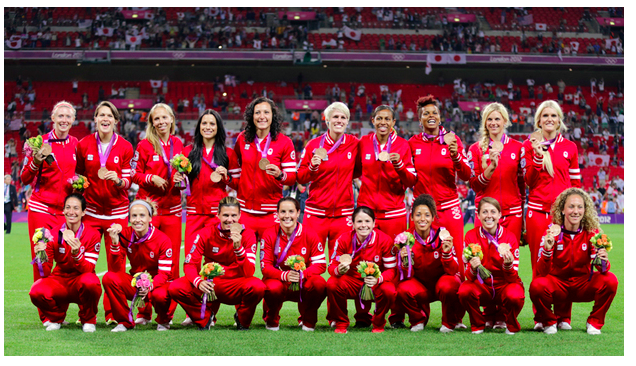
Canadian women’s 2012 Olympic soccer team. Our valiant warriors of the Great White North! (Photo by: Toru Hanai/Reuters)
When I was growing up I played a lot of soccer. Apologies, but I am Canadian with a die-hard Dallas Cowboys fan for a father. Football to me will forever be synonymous with giant muscle laden men wearing very tight stretchy pants and overhyped million dollar Superbowl commercials. 

Anyway, sometimes when playing a particularly good team our coach could be heard screaming from the sidelines, ‘Clutterbuck! Stop hiding out there and get in the bleeping game!!’. Coaches aren’t always known for their diplomacy skills. What I imagine he was attempting to communicate, if he had taken a moment to compose himself was, ‘Stephanie, please refrain from shying away from your responsibilities on the field as a defensive midfielder. Your teammates would appreciate it if you would mark your opponent properly and stop cowering behind the keeper.’ 

Now I loved playing soccer, I loved my teammates and I was generally able to hold my own, so to speak, on the field. So why was I hiding? I was hiding because the girl I was meant to be marking was stronger or faster or more skilled than me. Sometimes she was all three of these things at once. The dreaded triple whammy. Quite simply she was a challenge and a challenge can be terrifying. Don’t get me wrong when you think you stand a chance challenges are exciting and even energizing. However, when you think you won’t quite cut the mustard a challenge can be paralyzing. And at those times it always seems easier to hide. If you hide then no one finds out you are actually a crummy soccer player and your spot in the starting line up must have been a fluke. Likewise, if you never get down to writing your thesis no one realizes that you actually know nothing, are in fact a fraud and your supervisor(s) have made a massive mistake in giving you the Ph.D. post.

So how did I manage to stop hiding on the field when my opponent threatened to damage my pride? Well, to unabashedly steal and conjugate a catch phrase, I just did it. I did it to stop my coach yelling at me. I did it to avoid being benched for the rest of the season. I did it because I loved the game and I knew it wasn’t always going to be easy but that’s what I signed up for. 

As for writing my thesis, again, I will just do it. I will do it to stop my supervisors yelling at me (they don’t actually yell but disapproving silences are somehow worse). I will do it because I don’t want to be kicked out of grad school. And I will do it because I love the game (i.e. research) and I know it isn’t always going to be easy, but that’s what I signed up for.

Selasa, 13 November 2012

My PhD Experience

Posted by Annette Payne

The world of ‘The PhD’ was a complete unknown to me, one I never thought I would be part of until a ‘casual’ conversation in 2010.

I remember in 1988 waiting for my GCSE results thinking I would be lucky to pass any…..I ended up with 10!! Don’t get me wrong they weren't ‘A’ grades but they were C and above and got me onto my A-level courses……

I remember in 1990 waiting for my A-level results thinking I would be lucky to pass any…. I ended up with three!! Don’t get me wrong they weren't ‘A’ grades but they got me into university…….

Never an A-grade student

HANG ON! HANG ON! There is a theme here!! I'm now 40 (coughs) and can look back on my academic achievements (BA Hons, BSc Hons, Dip He, PGCE, MSc in case you’re interested) and see that I have finally found myself academically. I was never an ‘A’ student and always having degrees of shock when I academically achieved. I still don’t class myself as an ‘A’ student. Ask if I'm clever I’ll say no (my basis for this is I hate trivial pursuit, am rubbish at geography and can’t really speak any foreign languages apart from my bad hybrid Greek). BUT I have gained a few qualifications along the way. 

I was approached about doing a PhD in 2007 to which the polite version of my response was NO WAY!! I had just completed a three-year part-time MSc in two years while working full time and the thought of any other study, never mind the elusive PhD, was not on my to do list!!! The seed must have been sown however, because in 2010 I ventured over to Sunderland University for a ‘casual’ chat with the Professor of Nursing. I walked away with the offer of a PhD ringing in my ears. I remember my journey home that day so clearly. The words ‘oh my goodness I'm doing a PhD, I’m doing a PhD’ were being chanted non-stop in my head. I wasn't entirely sure how it had happened but from that moment, so began my PhD journey.

The reason for my shock was twofold. Firstly I never believed I was capable of completing the study required for a PhD - again not thinking I was clever enough. Secondly I was totally taken aback at the ease at which I was offered my PhD and the surprise the Prof demonstrated when I questioned my ability.

So after 12 months of work-up I finally registered in Feb 2011 and am now heading at speed towards the end of my second year. To my amazement I've sailed through all of my reviews, received a highly commended for my research at a nursing conference, had a couple of poster presentations, achieved some success with funding and had national interest in my research all of which without actually having any results. I've received my postal surveys back and have my first interviews scheduled next week OH MY GOODNESS I'M DOING A PHD!!!

As I said at the start of this post (my first by the way) the world of the PhD was a complete unknown to me and one I never thought I would be part of but I am now fully immersed in it. I can negotiate the bureaucratic process, the on-line library facilities, the studying alongside a full time job while having a life and finally realise I am quite bright (although still maintain that I'm not classically intelligent) but I have I think learnt how to study. My PhD has shown me that if you enjoy, or even love, what you are studying you can achieve as much as you desire. When I was at school my choice of subject was restricted (funnily enough I had little interest in learning Russian) and I think my academic attainment reflected this. As my academic career has progressed my choices on what I study have broadened and therefore so has my academic attainment and self-belief. You may ask why at the age of 40 (coughs) am I so determined and excited to complete my Doctorate?? The answer to that is very simple I long to be Dr A Payne. Mwhaaha haa ha ha (evil laugh).