Kamis, 05 Juli 2012
How To Write - by Harry Bingham
Harry Bingham knows his onions when it comes to writing and publishing. Actually, for all I know he knows his onions when it comes to onions, too.
Recently, he proved his utter good sense by giving my Write to be Published a lovely write-up on his blog. And he's invited me back to the Festival of Writing in York to deliver some more crabbit advice - even more advice than last year. In fact,

How to improve your productivity: don’t read this blog
Posted by Jonathan Ling
One of my first office mates was Roger.
He was an older academic who had just been recruited by my department. As I helped him carry boxes of books into our room, I noticed that at the top of one of them was a book with his name on the cover. I was impressed – I was sharing my office with an author! I told him how great it must be when someone said to him: “I’ve read your book”. He agreed that it was a nice feeling, but what felt even better was when, having written a couple more books, he was able to say: “Which one?”
I’d never really thought about writing a book myself, until I was asked a couple of years ago to co-author a short textbook. It was on a topic I knew a bit about, but I’d never met the co-author who came from a university at the other end of the country. The editor suggested that the process would be reasonably straightforward and fairly speedy. As he had written several books himself I thought he obviously knew what he was talking about.
With hindsight I now realise he must be significantly more methodical in his approach to writing than I am.
I eventually finished my part of the book and it was published last year. Mostly by trial and error, I learnt a few things as I went along:
1. Have a writing routine. Take time out of every day to write. If you don’t block out a specific time each day to write (and stick to it), you won’t get anything written. It doesn’t matter when it is (I work better in the afternoons), just hang a “Do not disturb” sign on your door, or around your neck, and get going.
2. Don’t get side-tracked. See point 1. Your writing time is for writing – it’s not time for admin, catching up with emails, fitting in meetings or reading engaging and erudite blogs.
3. Seek feedback from your target audience. Unless it’s your diary, everything you write is for an audience. Think about who the audience is, and make sure they get a look at it. For a textbook, this was undergraduate students and other lecturers. For a journal article, most likely it would be fellow academics, as well as practitioners or policy makers.
4. When all else fails, get an egg timer. There were some parts of the book where I really struggled – topics I was unfamiliar with, that required lots of reading and which I wasn’t particularly interested in. But I just had to grind these sections out. In one of my more (possibly only) fruitful side-tracks, (see point 2), I came across the Pomodoro technique. In essence, this is just working on your chosen task for 20 minutes (no email, no looking out of the window – just work!) and then having a 5 minute break before another 20 minute session. Try it sometime – it did the trick for me.
Eventually, with the help and support of my co-author, editor and publishers, the book was finished, proofread and published. It is nice to have a book on the shelf with my name down the spine. But it was a huge amount of work, on something that’s not REF-able. So it’s not something I can see myself doing again.
Although, in my weaker moments I can’t help but think that one day it might be quite nice to say “Which one?” when someone tells me that they’ve read my book….
One of my first office mates was Roger.
He was an older academic who had just been recruited by my department. As I helped him carry boxes of books into our room, I noticed that at the top of one of them was a book with his name on the cover. I was impressed – I was sharing my office with an author! I told him how great it must be when someone said to him: “I’ve read your book”. He agreed that it was a nice feeling, but what felt even better was when, having written a couple more books, he was able to say: “Which one?”
I’d never really thought about writing a book myself, until I was asked a couple of years ago to co-author a short textbook. It was on a topic I knew a bit about, but I’d never met the co-author who came from a university at the other end of the country. The editor suggested that the process would be reasonably straightforward and fairly speedy. As he had written several books himself I thought he obviously knew what he was talking about.
With hindsight I now realise he must be significantly more methodical in his approach to writing than I am.
I eventually finished my part of the book and it was published last year. Mostly by trial and error, I learnt a few things as I went along:
1. Have a writing routine. Take time out of every day to write. If you don’t block out a specific time each day to write (and stick to it), you won’t get anything written. It doesn’t matter when it is (I work better in the afternoons), just hang a “Do not disturb” sign on your door, or around your neck, and get going.
2. Don’t get side-tracked. See point 1. Your writing time is for writing – it’s not time for admin, catching up with emails, fitting in meetings or reading engaging and erudite blogs.
3. Seek feedback from your target audience. Unless it’s your diary, everything you write is for an audience. Think about who the audience is, and make sure they get a look at it. For a textbook, this was undergraduate students and other lecturers. For a journal article, most likely it would be fellow academics, as well as practitioners or policy makers.
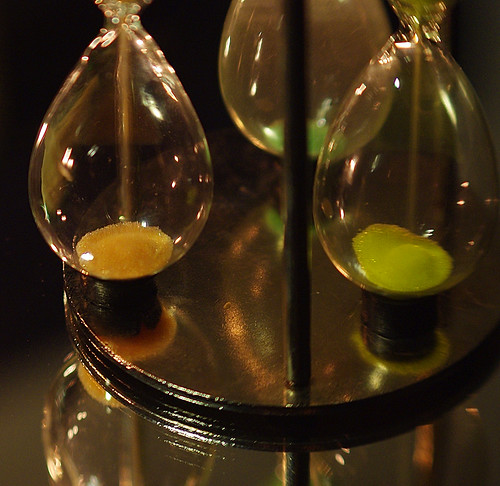 |
| Egg timer, by Martin Lopatka |
4. When all else fails, get an egg timer. There were some parts of the book where I really struggled – topics I was unfamiliar with, that required lots of reading and which I wasn’t particularly interested in. But I just had to grind these sections out. In one of my more (possibly only) fruitful side-tracks, (see point 2), I came across the Pomodoro technique. In essence, this is just working on your chosen task for 20 minutes (no email, no looking out of the window – just work!) and then having a 5 minute break before another 20 minute session. Try it sometime – it did the trick for me.
Eventually, with the help and support of my co-author, editor and publishers, the book was finished, proofread and published. It is nice to have a book on the shelf with my name down the spine. But it was a huge amount of work, on something that’s not REF-able. So it’s not something I can see myself doing again.
Although, in my weaker moments I can’t help but think that one day it might be quite nice to say “Which one?” when someone tells me that they’ve read my book….
Rabu, 04 Juli 2012
Turning the corner
Posted by Jean Adams
In university research there are two sorts of jobs: research jobs and academic jobs.
Research jobs are all about getting a particular research project done. Contracts are time-limited and you do research – collect data, analyse results, write reports. Academic jobs tend to be permanent and involve the classic triad of research, teaching and administration. The research bit is more about leadership than in research jobs – submitting grant applications, and supervising researchers employed on your projects. But there is also classroom teaching and student supervision. And let’s just not talk about the admin.
You can see why many people might aspire to an academic position - for the job security if nothing else.
In university research there are two sorts of jobs: research jobs and academic jobs.
Research jobs are all about getting a particular research project done. Contracts are time-limited and you do research – collect data, analyse results, write reports. Academic jobs tend to be permanent and involve the classic triad of research, teaching and administration. The research bit is more about leadership than in research jobs – submitting grant applications, and supervising researchers employed on your projects. But there is also classroom teaching and student supervision. And let’s just not talk about the admin.
You can see why many people might aspire to an academic position - for the job security if nothing else.
 |
| Turning the academic corner |
I wouldn’t be an academic if I didn’t now say “well, that’s actually a bit of an oversimplification, really – but it gives you an idea, doesn’t it?”.
Even before I finished my PhD I wanted an academic position. I wanted to ‘lead’. I wanted to teach. And after all those years as a full-time student (n=9), you betcha I wanted a nice, healthy pay-check every month forever.
I spent four years as a post-doctoral researcher before getting my first academic position. Less time than many, and for this I am very grateful. Now, a further four years on, it occurred to me recently that only now am I actually doing the job.
Although I knew all that stuff about the difference between research and academic jobs, when I first made the transition myself it seemed like nothing changed. Yes it was nice to stop getting those letters telling me that my contract was due to expire in three months. Yes it was nice to get a little bump in my salary with promises of more in due course. Yes it was nice to put “Lecturer in Public Health” in my email footer. But that was about it. My day-to-day job was pretty much the same. I analysed data, wrote papers, suggested ideas for projects to senior colleagues, shied away from any real responsibility.
And then I got scared. I wouldn’t be the “new lecturer” able to hang on the coat-tails of more senior colleagues forever.
And then I got more scared. I knew I had to get some grant funding, make sure my post-grad students flourished, and deliver good teaching. I tried to do all these things. But I didn’t seem very good at any of them. My grant applications were rejected. My post-grads seemed unable to tie down their research questions, let alone do some research. The big lecture theatre petrified me.
But, you know, it does seem true what they say. Once you’ve started, it gets easier; you just have to start. I got a little grant funded. Then I got another, bigger one. Then I got another. My post-grads are making their own, individual, journeys towards completion. I look forward to teaching seminars (although not preparing them) and whilst the big lecture theatre still scares me, I don't think it shows so much anymore.
So here I am just starting to think that I have finally turned the corner and might truly be doing the job I’m paid to do. And guess what? From August, they've promoted me.
Even before I finished my PhD I wanted an academic position. I wanted to ‘lead’. I wanted to teach. And after all those years as a full-time student (n=9), you betcha I wanted a nice, healthy pay-check every month forever.
I spent four years as a post-doctoral researcher before getting my first academic position. Less time than many, and for this I am very grateful. Now, a further four years on, it occurred to me recently that only now am I actually doing the job.
Although I knew all that stuff about the difference between research and academic jobs, when I first made the transition myself it seemed like nothing changed. Yes it was nice to stop getting those letters telling me that my contract was due to expire in three months. Yes it was nice to get a little bump in my salary with promises of more in due course. Yes it was nice to put “Lecturer in Public Health” in my email footer. But that was about it. My day-to-day job was pretty much the same. I analysed data, wrote papers, suggested ideas for projects to senior colleagues, shied away from any real responsibility.
And then I got scared. I wouldn’t be the “new lecturer” able to hang on the coat-tails of more senior colleagues forever.
And then I got more scared. I knew I had to get some grant funding, make sure my post-grad students flourished, and deliver good teaching. I tried to do all these things. But I didn’t seem very good at any of them. My grant applications were rejected. My post-grads seemed unable to tie down their research questions, let alone do some research. The big lecture theatre petrified me.
But, you know, it does seem true what they say. Once you’ve started, it gets easier; you just have to start. I got a little grant funded. Then I got another, bigger one. Then I got another. My post-grads are making their own, individual, journeys towards completion. I look forward to teaching seminars (although not preparing them) and whilst the big lecture theatre still scares me, I don't think it shows so much anymore.
So here I am just starting to think that I have finally turned the corner and might truly be doing the job I’m paid to do. And guess what? From August, they've promoted me.
Selasa, 03 Juli 2012
Wedding Card
Masterpiece baru yang terinspirasi dari sebuah acara pernikahan salah satu dosen di Universitas Gunadarma yang bernama bu Rodiah yang menikah dengan suaminya Andri.
Pada awalnya saya bingung ingin memberikan hadiah apa, yang terlintas dipikran hanya membuat sesuatu yang berkesan, buatan tangan, tetapi waktunya terlalu mepet, karena saya baru tahu pernikahan akan dilaksanakan H-2.
Terlintas dipikiran saya untuk membuat wedding card, namun isinya belum tahu harus bagaimana bentuknya. Lalu saya bertanya kepada Riko Arfian bagaimana isinya, lalu ia menanggapi membuat ucapan dengan program python!. Nah, karena beliau mengajar python di kelas saya, cocok deh saya lanjutkan membuat poster wedding card, dengan layout menggunakan CorelDraw X6, untuk program pythonnya saya buat dulu agar tidak asal-asalan.
Setelah selesai semua saya buat ulang tampilan pythonnya di corel agar terlihat jelas, tidak dengan printscreen. Hasilnya seperti dibawah ini:

Senin, 02 Juli 2012
Exclusivity and Free
I'm back from a two week vacation, and today I'm discussing the merits and problems with exclusivity and free ebooks with Blake Crouch, and his brother Jordan.
Blake and Jordan have a new ebook horror-thriller out called EERIE, which is currently free on Kindle.
Download it. It's a great book.
 For the sake of experimentation, EERIE didn't debut on Kindle. In fact, it has been available for several weeks.
Here are the Crouchs to explain why.
NOOK
A lot of people also ask me if it is a good idea to sign with one of Amazon's publishing arms. Blake and I hit the #1 Bestseller spot because of the push Amazon gave Stirred, something I haven't been able to do on my own. But was it worth the sales I lost on other platforms?
I don't believe so.
If Amazon wants me back in KDP Select, they'll have to offer more. And if Amazon Publishing wants another book from me, they'll have to offer more. Exclusivity, and signing away rights, isn't how I see the future. Authors should be able to keep their rights, and exploit them in as many ways as possible.
But the cloud is still a concept that hasn't entirely caught on. People do like to own media. More people will own us than read us. It'll always be that way. There's no guarantee a book owned will be read, even if that book was bought. Adding more choice to the equation doesn't matter. We've always had a lot of choice.
Blake and Jordan have a new ebook horror-thriller out called EERIE, which is currently free on Kindle.
Download it. It's a great book.

Here are the Crouchs to explain why.
JORDAN: Blake and I shared a room for five years while we were growing up. Bunk beds, one closet, and a single dresser. When our father finished the basement, he built a second, even smaller bedroom with no windows and a door that locked, behind which my older brother disappeared and was never heard from again. Twenty years later we find ourselves sharing another space. This time, it's the page.
I guess it should come as no surprise then, that our first book together is about siblings trapped in a house. EERIE [free on Amazon today] follows an estranged brother and sister as they try to uncover the mystery of the violent presence that inhabits the upstairs bedroom.
Here's this pitch:
From newcomer Jordan Crouch and Blake Crouch, author of the Top-10 Kindle-bestsellers Run, Stirred, and Fully Loaded, comes Eerie, a chilling, gothic thriller in the classic tradition of The Shining and The Sixth Sense.
TRAPPED INSIDE A HOUSE
On a crisp autumn evening in 1980, seven-year-old Grant Moreton and his five-year-old sister Paige were nearly killed in a mysterious accident in the Cascade Mountains that left them orphans.
WITH A FRIGHTENING POWER
It's been thirty years since that night. Grant is now a detective with the Seattle Police Department and long estranged from his sister. But his investigation into the bloody past of a high-class prostitute has led right to Paige's door, and what awaits inside is beyond his wildest imagining.
OVER ANYONE WHO ENTERS
His only hope of survival and saving his sister will be to confront the terror that inhabits its walls, but he is completely unprepared to face the truth of what haunts his sister's brownstone.
Although I’ve been writing for close to ten years now, it’s always been as a personal outlet, not a serious professional endeavor. I’m really excited to say that’s about to change. This book represents a lot of firsts for me. My first novel, my first collaboration with Blake, and my first foray into self-publishing. So in the spirit of the blog, I'll talk about the experience with the collaborative process as the Newbie that I am.
I've read Blake's stuff for as long as I can remember: the good, the bad, and the humiliating high school creative writing projects. It’s not lip-service when I say that he’s one of my favorite writers. So, when the opportunity to work together presented itself in November of last year, it was an easy decision. We already had the basic idea for what would become EERIE, and over the next few months, we sequestered ourselves inside a Google Doc and hammered out the first draft.
If you've never used Google Docs before, here's what you need to know: it's a word processor that allows multiple users to edit the same page in real time. Like a big dry-erase board. As a collaborative tool it’s great, but for two brothers, it’s the creative equivalent of sharing a room again. There's nothing more humbling than watching a sentence you just carefully arranged disappear word-by-word and be replaced by another thought entirely.
That's the license we agreed to give each other. If something felt wrong or lacking or just plain stupid, strike it. Sometimes it hurts, but the price of collaborating is giving up a certain amount of control. Of course, that's easier said than done, and diplomacy did not always prevail. But on the few occasions when we resorted to the nuclear option, we always ended with something better than we had before.
Writing is an intensely personal endeavor. If you can make it work with someone else, it’s awesome. If that person is your brother, well that’s pretty special.
BLAKE: This was my fourth collaboration. I've written extensively with Joe, and then with Joe, Jeff Strand, and F. Paul Wilson, for Draculas. I collaborated with Selena Kitt on our short story Hunting Season. But this was different. My brother has been a writer for a long time and got a degree in creative writing from UNC-Wilmington. I'd always wanted to collaborate with him, because he's one of my most important sounding boards in the writing process. We finally hit upon an idea we were both very excited about, and though there were some speed bumps along the way, we persevered, and are immensely proud of the final product. It's essentially a monster-under-the-bed story, something that plays upon every child (and inner child's) greatest fear.
I've rambled on at length on this blog about collaboration, so I thought I'd share my experience on EERIE from the perspective of its publication.
With the dawn of KDP Select last December, exclusivity has become an increasingly divisive and provocative aspect of self-publishing. There are essentially five viable platforms--KDP, Pubit!, Smashwords, Kobo, Sony, and Apple (no, I didn't forget to mention Diesel. On the latter platform, I've sold a grand total of 1 book in my entire career, and I have a feeling that's more than most.)
NOOK
For EERIE's initial release, Jordan and I decided to try the Pubit! Nook First program. This is Barnes and Noble's interesting take on exclusivity wherein, by invitation, they offer you merchandising and promotion in exchange for releasing a new work straight to their platform for a 4-week period. After that period, you're free to publish everywhere.
I don't know what other writers' experiences with Nook First have been, but for the most part, Jordan and I were pleasantly surprised. We sold about 1500 copies of EERIE (@ $3.99) in May for Nook, which I know is far more than we would've sold on Barnes and Noble on our own. There were some disappointments, however. Despite huge sales on a handful of days, our sales rank was wonky. It never seemed to correlate to a corresponding low rank. Even on days where we sold 400 books, our rank never dropped below 2000. I have no doubt this cost us many, many sales, a good chunk of money, and kept the book from every appearing on the BN bestseller lists. A real shame, because the marketing triggers that Pubit! pulled worked in a big way. The tech just wasn't there to support them, and their tech support staff just couldn't be bothered to give a damn.
But that aside, Pubit! clearly has some real marketing power, and the smaller window of exclusivity (as opposed to KDP Select's 90 day commitment) is a definite plus. When Pubit!'s tech support decides to follow the model of Kobo and Amazon and treat writers as customers instead of entities to be ignored, Pubit! could become a force.
KOBO
Also in May, I had the opportunity to drop my best-selling title RUN into a Kobo promotion involving email blasts, coupons, and prominent placement on their landing pages. I could not have been more pleased with the results. RUN reached the top 10 on Kobo's overall list, stayed there for several weeks, and the rest of my catalog sold well in response. When you consider the size of Kobo's market share, the fact that I sold more books on Kobo in May than I did on Pubit! is astounding. It was only a few hundred dollars shy of beating Amazon for May, and it did beat Pubit! again in June. Even better, Kobo did not request exclusivity. Their writer-relations people are some of the friendliest, most proactive, responsive people in the business. Suggestions and requests I made last year were taken to heart. It's no secret that Kobo is on the verge of unveiling their own platform (Writing Life). If there is a company that could one day compete with the mighty Amazon, it's these guys. They're inventive, have far, far reaching plans to bring writers what could become the slickest digital publishing platform ever created, and they get that writers are customers. They listen. Best of all, my titles continue to sell and rank highly on Kobo's bestseller list, a month after the promos ended. I cannot say the same for Barnes and Noble. There is no other platform (aside from Amazon) where I've seen this level of "stickiness." If someone asked me what's keeping the majority of my titles out of KDP Select, I would have to say these guys.
AMAZON
KDP Select opinion pieces are a dime a dozen. Amazon is still, hands down, the most lucrative platform for me. Even though the transition from free to paid sales appears to have weakened as of late, success stories like Ann Voss Peterson and Robert Gregory Browne are convincing enough for my brother and I to roll the dice and drop EERIE into KDP Select. I say this as someone who has had great success with free titles: they still make me nervous. I get the excitement of giving away 70,000 ebooks. The prospect of making new fans. But free, in the long run, is dangerous. It sets a bad precedent and level of expectation in the minds of readers. Am I a hypocrite for saying this while EERIE is free? Maybe. But if all the platforms did away with free, I'd be okay with that. As writers, we cannot keep going to that well. It will dry up. Kindles may be able to hold a gazillion ebooks, but readers can't read that many. The key is not being downloaded. It's being read.
This post is not going to end with a definitive conclusion on freebies and exclusivity. I'm uncomfortable with both concepts, even as I play the game. My sense is that the people who survive and continue to do well selling ebooks will be those who experiment, take risks, and adapt. We've said it before, but what worked yesterday, may not work today, and the possibility of a game changer (like KDP Select) is constantly looming.
JOE SEZ: I predicted that ebook retailers would seek exclusivity back in 2009. It's an obvious conclusion to draw when retailers compete. If there is a commodity that people want, and it is only available at one place, they'll shop at that place.
The author is the brand. I've lost count of the emails I've gotten from Nook and Kobo ereader owners who are wondering when Shaken and Stirred (both published by Amazon) will be available on their devices. That's one of the reasons my ebooks are DRM free--so readers can convert to other formats like epub to read on devices other than Kindle.
So how effective is exclusivity as a sales tool for Amazon? I've had people email me who bought a Kindle just to read Shaken. But how many more of my fans are annoyed because they own a different ereader that doesn't allow for a one-click purchase of Shaken? How many sales are lost?
My guess is: a lot. Shaken and Stirred have done well, but Blake and I have done better on self-pubbed projects.
For me to be exclusive with a retailer, I have to know the sales I'm going to lose will be made up for with increased sales on the exclusive platform. Long term, that's risky. After the big initial sales push, sales will even out, and years from now the lost sales will really rack up.
This is a related dilemma I'm having with foreign sales. My agent has been great in selling foreign rights to my self-pubbed ebooks. But do I want to give up future sales (which I'd have if I kept my rights and translated the ebooks on my own) for immediate sales?
I've been nudging Amazon for years to release titles in epub format. Let Nook owners buy my ebooks on Amazon. And let Kindles read epub format. I think that would make more money for everyone.
But until that happens, we're going to have retailers jockeying for market share, and one of the ways to do that is to have exclusive brands (ie authors).
A lot of people ask me my opinion about KDP Select, and I made it known that I have opted all of my titles out of it. I dislike Amazon's desire for exclusivity, because it limits my readership.
Back in January, it was possible for an ebook to be released free on the KDP Select, then bounce over to the Top 100 paid bestseller list. This is still possible, but a lot harder to do, and I'm not sure it justifies removing a title from other platforms to do it. I'm also not sure it does what Amazon wants it to do: lure customers to the Kindle platform. If Amazon wants to sell more Kindles, it should have as many ebooks in the KDP Select program as possible. But when authors like me opt out, that hurts readers.
I might be missing some important parts of this story. No doubt Amazon is crunching numbers, and they probably know how to find that sweet spot among ebook sales and freebies and Kindle sales and Prime memberships. But I know I'm not the only author they are disappointing, and in the long run that won't be good for them.
Like Blake, I'll soon be doing a thing with Kobo, and I hope to replicate his results. I like that Kobo doesn't demand exclusivity. They want to please their customer base and make their website a worthwhile place to shop.
That's the line a retailer has to walk. Bringing new people to your online store (and ereader) while also making your current customers happy. Exclusivity might bring in new customers, but it will also irritate your current customers as more and more authors leave the platform.
Amazon is THE place to shop online. The shopping experience is better there than anywhere else. They make shopping easy, fast, and enjoyable. It's understandable that they want to sell more Kindles and Prime memberships. It's understandable that they don't want people buying Nooks or Kobos. But if KDP Select was non-exclusive, and Amazon sold epub, that would benefit all authors and all consumers, and irritate nobody.
It is in my best interest, as an author, to try as many things as possible, and for many platforms to succeed. I want the whole world to read my ebooks. And I don't care what ereader they read them on, or what store they buy them from.
Kobo gets that. Amazon sort of does. B&N, not so much.
As I've said in the past, the only two parties needed are writers and readers. The retailer who treats its writers and readers well will flourish. You do this by learning what these groups want.
So I'll make it real easy:
Readers want as many titles available as possible, without DRM, in multiple formats. They want to get ebooks with one-click. They want lower prices, and free ebooks. They want a fun, easy, fast place to shop. They want to have titles recommended to them, either by algorithms or other readers. They want to be able to contact and interact with each other, and with authors. They want to be listened to and have their needs and concerns met.
Writers want their work to be available as widely as possible, in multiple formats. They don't want exclusivity. They want to be able to interact with their retail partners and publishers easily and promptly, and to be treated well. They want high royalties, and the ability to control price (including the ability to make their ebooks free). They want data that can help them optimize their pricing and sales, and platforms that make accounting and joint-accounting a cinch. They want to be paid promptly. They want the ability to work directly and outside the box with retail partners and publishers and try new things. They want a stable platform where titles disappear immediately if removed and appear immediately if added, and where sales and rank are updated quickly and accurately. They want more bestseller list categories (like Top 100 Female Police Procedurals Priced at $2.99) and more BISEC categories. They want to be listened to and have their needs and concerns met.
Blake, why the hate for freebies?
BLAKE: I don't hate freebies. But why will readers buy ebooks if there are more freebies to download than they could possibly read in their lifetime?
JOE: Because that's human nature. We collect. We horde. We buy more than we can ever use. That doesn't mean we reach a point where we stop buying, or acquiring. We all have To Be Read piles. Ebooks have made them easier to attain and manage.
BLAKE: More than we can ever use. That's what worries me. If a TBR pile is suddenly 1000 books instead of two dozen, and my book is #899 in the pile, what are the chances I will be read? If someone downloads my book for free, but never reads it, they won't become a fan and buy the rest of my paid catalog.
JOE: There are a few things happening here. First, there's a difference between being owned and being read. That difference has always been there (and I say "owned" instead of "bought" to include freebies, and even though ebooks are essentially a licence and not a purchase). We all own more media than we'll ever be able to experience. The whole concept of the "cloud" plays into this. Why own anything if it is all always available to access?
BLAKE: But if I pay money for that book because I heard about it and found it through reviews or whatever, the chance that I'll read it is better than if I just grabbed one of 20 freebies listed on Pixel of Ink.
JOE: We read what we want to read, free or not. I've bought $30 Blu-Ray disks that sit unwatched on my shelf for 5 months, and instead I've surfed YouTube for free for 90 minutes. But YouTube didn't stop me from buying. And I'll watch the Blu-Ray eventually.
That's a human mentality. We want to be able to access media whenever the mood hits. So maybe we'll stock up on freebies for a rainy day, and maybe that rainy day comes and maybe it doesn't, but I don't see it limiting or hurting sales.
We have paper bestsellers because of a lack of choice. Only so many titles can fit on the shelf at Costco. More choice is a good thing.
BLAKE: You don't think there's a segment of customers, possibly very large, who have so loaded up their Kindles since Christmas and KDP Select came into being, that they don't actively shop anymore, because they have so many titles they want to read?
JOE: You've been to my house. How many books do I have? Video games? Movies?
BLAKE: You've got a few.
JOE: I've got tens of thousands. And this morning I was on Amazon and I bought 5 new Blu-Rays, two ebooks, and a video game.
My rule is: I only use marketing strategies that work on me. Which means I think a lot about my buying habits, and my media habits. While I'm sure there aren't many people out there with tens of thousands of books, movies, and games, I'm also sure the principle of what I'm saying is widespread: having enough doesn't inhibit acquiring more.
If someone gets your ebook for free, it doesn't mean you lost a sale. They may not read it, but they might never have bought it either. And people may be downloading a lot of free titles, but not reading them. Free, however, is a way for a customer to try you without any risk. Even if only a small percentage of freebies get read and make readers into fans, I believe that's still worthwhile.
BLAKE: So you think the free model is viable for the long haul? You don't think it trains people NOT to pay for books.
JOE: You know my belief on this. Eventually, all media will be free, and artists will be paid by advertisers. People can't be trained to pay more. That doesn't work. They'll get it for as little as they can get it for, and that ultimately means free. Rather than fight that, I'm happy to give consumers what they want. So I've made my titles free, I have no issues with file sharing, and I'm looking forward to a future where ads are in ebooks. But that's the topic for another blog.
My final point is: don't fight what the customer wants. If customers want free ebooks, give them free ebooks. So far it hasn't hurt my sales, and I don't expect it to.
Readers are very good at vetting, at finding what they want to read, free or paid. Our jobs as writers should be feeding those readers in any and all ways that we can. If you find readers, the money will follow.
Venice
Posted by Dorothy Newbury-Birch
I’m at a conference in Venice and I think it's the most beautiful place I've ever been to. But, with a bit of time on my hands (there’s no English TV in the apartment I’m staying in), I'm wondering why we come to conferences. I've probably been to about 50 conferences, heard around 300 speakers and seen hundreds of posters. I can only remember a handful of any of them.

I sat on the boat to the conference venue today (yes in Venice it's a boat not a bus!) and talked with an academic from Kansas about research in schools - a really useful conversation for a project I'm currently working on. During lunch, I chatted with some colleagues from Barcelona about a European project we are involved in. Over coffee yesterday I talked with someone from Cardiff about complex methodologies and had a chat with a member of the steering group for a recent UK trial we worked on. On the boat back from the venue, I chatted with a researcher from the USA about the differences in obtaining ethical approval in America and the UK.
These are just a few of the many conversations I have had in the last two days. I have also been introduced to some important people in the field who I didn't know before.
I know others find this whole networking thing really difficult. Anyone who knows me will know that my two greatest loves are talking and biscuits, so for me it's fantastic. But it's more than just chatting. These events give me time to think about past, present and future research and to explore ideas with others who are giving themselves the time to do the same.
They give me time to ponder and that's a good thing and that's why I come to conferences.
I’m at a conference in Venice and I think it's the most beautiful place I've ever been to. But, with a bit of time on my hands (there’s no English TV in the apartment I’m staying in), I'm wondering why we come to conferences. I've probably been to about 50 conferences, heard around 300 speakers and seen hundreds of posters. I can only remember a handful of any of them.

We’re told that its important for us to attend conferences and disseminate our work. But as I stood in front of my carefully crafted poster today for an hour and a half in the baking heat and spoke to a grand total of three people I wondered just how much dissemination was happening. I once gave an oral presentation in America to three members of my research team and someone who I think was in the wrong room but felt too bad to leave. I have, of course, also given presentations in front of hundreds of people.
So why is it so important and why do I keep coming to conferences? Well the reason is that by coming to these conferences I ‘connect’ with other like-minded people from around the world. I chat with people about their research and my research and we talk about how we can perhaps collaborate on future work.
So why is it so important and why do I keep coming to conferences? Well the reason is that by coming to these conferences I ‘connect’ with other like-minded people from around the world. I chat with people about their research and my research and we talk about how we can perhaps collaborate on future work.
I sat on the boat to the conference venue today (yes in Venice it's a boat not a bus!) and talked with an academic from Kansas about research in schools - a really useful conversation for a project I'm currently working on. During lunch, I chatted with some colleagues from Barcelona about a European project we are involved in. Over coffee yesterday I talked with someone from Cardiff about complex methodologies and had a chat with a member of the steering group for a recent UK trial we worked on. On the boat back from the venue, I chatted with a researcher from the USA about the differences in obtaining ethical approval in America and the UK.
These are just a few of the many conversations I have had in the last two days. I have also been introduced to some important people in the field who I didn't know before.
I know others find this whole networking thing really difficult. Anyone who knows me will know that my two greatest loves are talking and biscuits, so for me it's fantastic. But it's more than just chatting. These events give me time to think about past, present and future research and to explore ideas with others who are giving themselves the time to do the same.
They give me time to ponder and that's a good thing and that's why I come to conferences.
Minggu, 01 Juli 2012
DEAR CRABBIT: encouragement from this rejection?
The latest question for Dear Crabbit is a tricky one:Hi Nicola
I am currently submitting my first novel to literary agents and have had four standard rejections. The other day I received a personalised rejection from a prominent agent in one of the big agencies, enthusiastic about the premise of my book but briefly explaining why she didn't quite warm enough to the writing to represent me - and
I am currently submitting my first novel to literary agents and have had four standard rejections. The other day I received a personalised rejection from a prominent agent in one of the big agencies, enthusiastic about the premise of my book but briefly explaining why she didn't quite warm enough to the writing to represent me - and
Langganan:
Postingan (Atom)